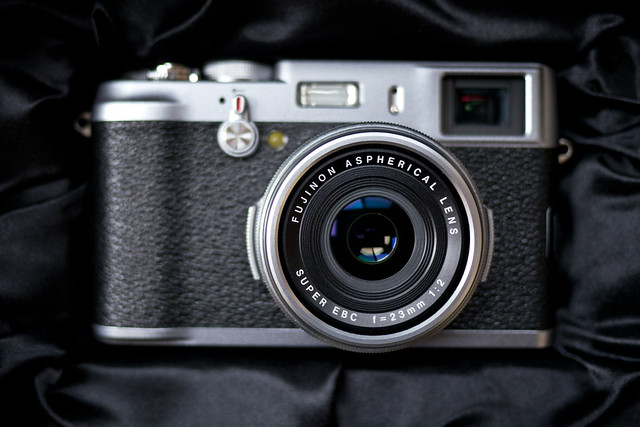
The Fujifilm FinePix X100 has definitely got to be one of the most hyped-up cameras for street photography? What could we complain on? It has an optical viewfinder, has the looks of a retro rangefinder, and is pretty solid on price. From recent reviews there has been disappointments in terms of the auto-focusing speed, the manual focusing, as well as some small quirks here and there.
If you guys were able to design the second version, how would you change the Fujifilm FinePix X100? Leave a comment below and tell us what you would do!
Also below are some of our Fujifilm FinePix X100 Reviews:
"Morning Ashram" - Adam Mareli (Leica M9, 75mm Summicron)
"Morning Ashram" - Adam Mareli (Leica M9, 75mm Summicron)
Eric’s Note: For this guest blog post, I am honored to have Adam Marelli talk about his experiences shooting with a Leica M9/M6 for street photography. This blog post will be especially helpful for those of you who currently shoot with a DSLR or are currently thinking about making the jump to a rangefinder. Make sure to read more to see his inspirational images and great thoughts on the pros of using a Leica rangefinder for street photography.
The Think Tank Retrospective 30 for Street Photography (like my shoes?)
As a street photographer who is always trying to capture fleeting moments, its important to always have your camera by your side. With the craziness of everyday life this can often be extremely difficult. That’s why I highly recommend everybody to get a messenger bag for their street photography, as it is a casual way to always have your camera by your side (without sticking out like a sore thumb). The kind folks over at Think Tank photo were generous enough to send me over the Think Tank Retrospective 30, their specialized camera bag for street photographers. Having used it for about two weeks now, I can say flat-out that I am in love. Read more on this review to get the gritty on this essential piece of equipment. Warning–there is a ton of photos below (and also a video!).
A design company based out of Los Angeles called Black Design Associates, LLC, just posted some sexy photos of a Leica M9/iPhone 4 Hybrid concept. They imagined the i90 to take any regular iPhone 4 and make it something more powerful and did I say sexy? The imaginary specs and images are below.
Recently one of my readers, David Cohen de Lara, showed me some awesome mocks of what would be his “ideal street photography camera.” I love the clean and minimalistic design, and the nice viewfinder in the middle as well. Make sure to click below to see a bigger version, and check out his website as well.
What do you think of David’s mockup? Leave a comment below and tell us what your ideal street photography camera would have.
As a street photographer, having a good messenger bag is essential to ensure you will always have your camera and equipment by your side. Often people ask me what bag I use, which is the Timbuk 2 Commute 2.0 Messenger Bag. It is not a camera bag per-se, but I have found out it works incredibly well, especially when you put in a Padded Camera Insert. Check out this quick review I did of my bag below!
What camera bag do you swear by when it comes to street photography? Leave a comment below!
Eric’s note: Below is a guest post from MarkB over at X100photo.co.uk. He is not only a talented street photographer, but he is passionate about the new Fujifilm FinePix X100. Check out his awesome review and thoughts below.
Question, can the X100 replace a DSLR or point & shoot and be a primary street photography camera?
With the release of ever more capable cameras that have the maturity of DSLRs but in more compact packages, this seems to have created a renaissance in the somewhat related genres of street, documentary and photojournalism. So as I thought about how to answer the above question I realized that with more and more photographers considering rightsizing their camera choice for street photography, this really is the question of the moment. The X100 then, really has set the cat amongst the pigeons.
This is not another in-depth review of the Fuji X100. What I aim to do is outline the factors we might take into account when trying to answer the above question. Perhaps a little more controversially, I then present my own conclusions! If nothing else, I hope my approach in breaking down the considerations might provide a useful means of making what is for many photographers a very individual decision.
Want to snag a hot Fujifilm FinePix X100 as soon as you can? Well unfortunately according to Engadget, Â these bad boys won’t be shipping until late March/early April in the US due to production shortages (they sold too many pre-orders). Looks like we have to wait and twiddle our thumbs until it comes out.
Over at Steve Huff’s blog, street photographer Pieter Franken gave his first impressions about the Fujifilm FinePix X100. He is originally from Holland and currently lives in Tokyo (where he was able to get the camera). Although he already has the Leica M8 and the Leica M9, he comments that it is a great companion camera (not nearly a replacement for either). All-in-all, Pieter gives the X100 a glowing review and mentions it is great for High ISO, the silent shutter, Â as well as the compact size. Read the review for more in-depth details.
Pieter Franken also has a plethora of sample street photographs on his Flickr as well (which look great in my opinion). Click more to view the sample street photographs, as well as the unboxing and review.
Recently I was browsing the Leica Rumor blog and saw these renders for a Leica concept camera (not affiliated with Leica). So what do you think about the images and the concept–are they hot or not? Leave a comment below and let us know what you think!
If you thought that the Leica M9 was expensive, check out the limited edition Leica M9 Titanium. The difference? There has only been a limited quantity of 500 Leica M9’s produced, and each are individually numbered and packaged with a Summilux-M 35mm f/1.4 titanium lens. Oh yeah, and it costs $26,500 (compared to the $6900 Leica M9). Only the seriously wealthy and eccentric photographers can probably get their paws on this, but for the rest of us commoners, we can still dream. Check out this unboxing video below.
The stupidest looking thing for your camera, ever. I doubt you will see any photo-journalists using this in the jungle.
A true photographer's camera.
I have always been a firm believer that photographers should use and abuse their gear. This means that you shouldn’t be scared to get little scratches and minor nicks in your camera when you are out exploring for photos. This means that you shouldn’t handle your camera like a newborn child. This means that you shouldn’t worry more about the warranty than actually taking photos. This means that you shouldn’t leave your camera at home in fear of getting in stolen.
Fujifilm FinePix x100 Camera. My next camera for street photography.
My good friend and fellow street photographer Tom Kaszuba just informed me that Fujifilm has their FinePix x100 Sample Photos live on their site. I have taken the liberty of showing you some photo samples which show how awesome a camera it can be for street photography with its pancake 35mm f/2 lens. Keep reading to see more pictures of the camera, as well as the hot and new sample photos!
The Panasonic Lumix 12.5mm f/12 3D G Lens. Looks pretty damn go ofy
The Panasonic Lumix 12.5mm f/12 3D G Lens. The future is here!
Recently my friend Jimmy Hahn sent me a link of the new Panasonic Lumix 12.5mm f/12 3D lens for the Panasonic Micro Four Thirds cameras: the GF2, G2 and GH2. When he first posted the link on my Facebook, I was taken back by how odd and funny it looked. Upon closer inspection, I was fascinated to see that not only is it a prime lens, but it is incredibly thin as well.
So Christmas is around the corner and you have been a good boy/girl this year. So you want to buy a new camera and/or some new lenses? Sure we know that it is the street photographer, not the camera that makes his/her photos amazing. But hey– it is always fun to experiment with new cameras and lenses as well.
I have gotten many questions from aspiring street photographers–asking what lens or body to get next. Read this list and pass it onto your loved ones (hopefully they love you enough to buy you some stuff in this list).
Also please note that these are my personal recommendations. If you don’t agree with this list, please leave a comment below and let me know whats up!
If you are interested in purchasing your first DSLR, I would highly recommend a used Canon 5D. You can get them used for only $1200, and they are full-frame, meaning that the lenses you get will show their true focal length. It is also phenomenal at low-light high-iso situations.
A bit short on cash? Check out the Rebel XSi or the Rebel XS (a bit cheaper). Both are small, and give great performance as well. Oh yeah, also heard great things about the Nikon D3000 as well.
If I was in the market for a new camera, it would definitely be for a micro 4/3rds. They are small, inconspicuous, and give fantastic image quality. Definitely the best “bang-for-the-buck” imho. I tried out Thomas Leuthard’s Panasonic GF-1 and instantly fell in love with it. Super-responsive auto-focus, and great image quality. I also heard that the EP-1 gives great image quality as well, but the autofocus is painfully slow.
Out of all the point and shoots for the street photographer out there, the Canon S95 (or S90) blow all the competitors out of the water. It is one of the smallest point and shoots out there, but offer great control with the front and rear dials–and has a super fast f/2 lens. Don’t consider anything else.
Update: If you have a little extra $$$ to spend, check out the Ricoh GRIII. It has a beautiful fixed focal 28mm 1.9 lens and with its “snap-focus” function, it has practically zero shutter lag (while the Canon S95 has a slight shutter lag). Also its built like a tank with its alloy body, and feels great in the hand as well. A worthy (but more expensive) competitor.
If you are interested in getting a digital rangefinder on a budget, check out the Leica M8. Sure it is not full-frame, but it will give you the true “rangefinder experience” without having to shell out $6900 on a Leica M9.
Lenses:
Primes (Canon)
(For full-frame)
The Canon 35mm f/2 is my lens of choice on my full-framed 5D. Small, inconspicuous, and sharp– it is the perfect walk-around lens for a street photographer. I personally like the 35mm focal length, as it is wide enough to capture a background, but at the same not too wide. Also note that the 35mm focal length is my preference, although many street photographers out there such as Markus Hartel prefer the 28mm focal length.
For 1.6 crop bodies, the problem about primes is that they are often too close. Therefore you are good getting a 20mm 1.8, which will translate into roughly a 32mm (close to a 35mm).
Haha–tricked you. As there is no “best†paintbrush for a painter, there is no “best†camera when it comes to the street photographer. The camera is merely a tool, and there are different tools required for different situations and tasks at hand.
In street photography as well as general photography, photographers can sometimes become more obsessed about camera gear over actually taking photos. Photographers who are obsessed with camera gear often feel that their images are lacking due to their equipment, when their underdevelopment of photographic vision is the culprit.
Therefore many individuals fall into this trap and go on a never-ending chase in the hope that buying more expensive camera bodies and lenses will help them get better images. However most of them are quite dismayed when they realize that when they buy the newest and most expensive equipment, their images don’t get any better. Now don’t get me wrong—nice bodies and lenses can indeed give you images with better sharpness, resolution, and color, but they won’t give one intrinsically better photos.
When it comes to street photography, I like to believe that the best policy is to have the least obtrusive camera and lens as possible. The antithesis of an ideal camera for street photography would be a 1D Mark IV with a Canon 70-200 f/2.8 L lens attached to it.
Although my knowledge of cameras may be limited when compared to the 20+years plus photo veteran, I will try my best to outline the pros and cons of different cameras that street photographers use, including rangefinders, DSLRS, or compact “point and shootsâ€.
Rangefinders
Rangefinders are glorified for their ability to take images without a battery, being small and unobtrusive, quick in operation, and virtually silent in terms of a shutter sound. Rangefinders are fully manual, meaning that you have to manually focus and manually control exposure through aperture and shutter speed.
The most popular rangefinder (by far) when it comes to street photography is the Leica. It carries all of the fore mentioned characteristics and has a tradition for being built like a tank with superior optics. Shoot—the granddaddy of all street photography (Henri Cartier-Bresson) used a Leica for his entire career.
Taking photos with a rangefinder is much different than many other cameras because what you see through your viewfinder is not necessarily what your photos show up as. There are superimposed grid lines showing the borders of how much your camera will actually capture which many photographers claim that gives them a sense of freedom and seeing entire scenes.
However there are obviously cons with using a rangefinder camera. First of all, rangefinders are fully manual, meaning that one has to learn how to constantly adjust for the changing lighting in an environment with aperture and shutter speed, while modern digital cameras can do this automatically. Although many advocates of using fully-manual settings do not see this as a disadvantage, the aspiring street photographer may have a difficult time constantly adjusting his or her settings.
Furthermore if one decides to get a digital Leica rangefinder, they are most likely going to drop a huge chunk of change.
DSLRS
It seems that nowadays many street photographers use digital SLRs (DSLRs) to take their photographs. DSLRs are massively popular due to their overall image quality, quick shutter speed, and their ability to interchange lenses, and relative affordability.
However the downside to DSLRs for street photography is that they are relatively large and clunky, and look intimidating to the average person. Furthermore due to the fact that it has a mirror inside, it makes a loud clicking (or clunking) sound when taking photos, which can disturb the serenity of a scene. There is nothing more apparent than the loud mirror-clacking of a DSLR on a quiet subway.
However that doesn’t mean that it is impossible to use a DSLR for street photography. I currently use a Canon 5D for my street photography and in order to make my camera more stealthy, I covered up my “Canon†and “5D†logo with black gaffers tape. I feel the advantage of this is that it converts my “professional-looking camera†into any old generic-looking camera. This makes the camera look less conspicuous in public, and makes people feel less anxious when you are taking photos of them.
Furthermore, DSLRS have great high-ISO capabilities, which make them ideal for shooting at night without having too much noise in the shots. The 5D is infamous for having creating clean images at even high-ISO’s. I never hesitate to shoot my camera at ISO 1600 or even 3200 at night when capturing scenes with faster shutter speeds.
Furthermore, another huge advantage of DSLRs is the ability to interchange one’s lenses. Therefore, one can switch up his or her lenses once in a while if you want to shoot at different focal lengths.
Generally for street photography, I recommend a 35mm “full frame equivalent” lens.
“The Corridor” – Shot by me with my Canon 5D in Prague.
Point and Shoots
There are currently a handful of high-end point-and-shoots on the market that many street photographers use for shooting in the street. These cameras tout larger image sensors, which gives better image quality as well as cleaner images at higher-ISOs.
The advantages of point-and-shoot cameras for street photography is that they are small, have a virtually silent shutter, and that they are unobtrusive. However on the other hand, many point-and-shoot cameras have shutter-lag, which can make it difficult to capture moving people without getting them blurred out.
“Sunflower” – Shot by me and my 5-year old Canon Powershot SD600
Micro 4/3rds
Micro 4/3rds cameras are also a fantastic option in street photography, because of their near instantaneous autofocus, small form factor and weight, as well as solid image quality. Their image sensors aren’t as good as Aps-c DSLR sized sensors, but they still make beautiful images you can’t complain about.