Something I’ve discovered —
Seeing some bodies, faces, physiques — the unnatural is grotesque.
Something I’ve discovered —
Seeing some bodies, faces, physiques — the unnatural is grotesque.
Because I am an artist I can do anything I want!


My method:
The internet, Google news web etc… infinite bad distractions and weird conspiracy theories?
The internet is bad.
Less maintenance? I don’t really want a lawn I gotta maintain.
I hate shit that breaks or I gotta fix or maintain! Even a roof?
Ultra goals —
ULTRA, ULTRA MAN… ULTRA CAR?
Also —
Beautiful body, beautiful soul.
Well the good thing is anyone and everybody can beautify their bodies naturally — weight lifting, 100% carnivore red meat organ meat diet, no drugs alcohol weed etc —
Nobody likes to think this but it’s true


Sorry but it’s true!
Oh yeah —
How to become sexier
Because nothing is sexier and better than us!
Deep Origin —
DeepOrigin.com— shout out to my best friend(s) Natalie Jing Ma.
45-pound cast iron weight lifting plate … the new coinage.
*NOT* how many USD you got— your plates! No more “racks†or “ bandsâ€
Elon Musk, Jeff Bezos, Peter Thiel — who else?
If strength, power, becoming stronger is the goal… And the only way to become stronger is to become buffer and bigger and more muscular and powerful after the text of others and physics… Shouldn’t we actually seek more conflict, attacks from others?
Antifragile process?
Caring too much about “quality“, seems like a trap.

Shout out to my friend Abe Eid — the first cryptocurrency whale I met at the LA fitness in Providence Rhode Island. Who first told me about chainlink explained it to me etc. 
Essentially it is a platform built upon Ethereum, the blockchain… that strives to solve real world problems.
The first critical issue at hand is the notion of the “Oracle problemâ€, and cryptographic proof and truth.
The general gist of the Oracle problem is that you have all these people purporting to say something… How do you know if someone is really telling the truth or not?
Also, they’re great innovation of a decentralized oracle network. I think anything that is decentralized and can be done offline is a good idea; anything that has to be done when you’re connected to the web is fragile.
For example, the “Internet of thingsâ€, which includes all of your home devices, your home stuff etc. I think this includes your home speaker things, your Amazon echo or echo dot, your Apple HomePod thing, your ring Amazon nest devices etc. 
TVE — transactional value enabled?
What is the purpose of technology and these things? A very basic idea is that the point is to help enable commerce and other things. Money makes the world go round, Publilius Syrus.
What is money anyways? Money is movement. Anything that literally physiologically moves human beings in time and space is money.
For example, if you promise somebody $30 an hour, they will walk around, move their bodies to clean toilets, etc.
Also, money movement. The whole global economy to me is so fascinating; because we process and move information so quickly and so globally… how do you link it all together?  
I find chainlink to be an interesting concept because wherever you go in real life, there are physical chain links everywhere.
Also, technically the internet, the World Wide Web, is a bunch of hyperlinks which link websites together.
My personal thought and prediction is that chainlink could become the next Google; Google indexes the whole internet, and made it easy for you to find any sort of website. What I think chainlink will do is link all of this information on the internet and computers and make them accessible, trustworthy, tamperproof. 
Only read stuff that you find interesting, skip over stuff you find boring.
About a week or two ago, I reread the original bitcoin white paper, and I was so impressed with how short it was, how minimalistic it was, and how to the point it was. But… reading it… this time around… felt a bit boring.
And this is the big thing: if something bores you, you got to get out of it.
Therefore, I sold or transferred or converted nine of my bitcoin and put it all into chainlink, at the time it was valued at ~20,800 LINK (CHAINLINK), with bitcoin at around $35,000 a bitcoin.
I think what I try to do is think at least 30 years into the future. 20 or 30 years. It is funny, as I write this at the age of 35, 30 years from now Seneca is only going to be 32 years old, still a few years younger than me. my personal aspiration is to hold onto chainlink for at least 30 years, and then maybe transfer it to Seneca when he grows up. Or I just help him build some sort of company or entrepreneurial venture etc.
I love bitcoin but maybe one of the big issues here is that bitcoin is like digital money and gold; most people just hold onto it, and I don’t think actually aspire to use it to actually pay for your latte at Starbucks or whatever. I think because bitcoin and cryptocurrency is so volatile; Everybody’s hope and dream and ambition is that their coin will rise value astronomically and they will become rich, by the Lamborghini or whatever… And be happy.
But this is not the case. I think crypto, cryptocurrency speculation is kind of more of an interesting game; prediction, prediction markets, trying to predict the future… Is just a luxury and a fun thing.
When I was in college college, my sophomore year, and I was starting to get into trading stocks, daytrading… I had a pretty certain thought that Blockbuster was going to go under. I tried to figure out how to short stocks, but I really couldn’t figure out how to do it.
Also I remember when the prime mortgage meltdown happen, and the value of Ford went to almost 2 dollars a year. I wanted to buy some Ford stock but I had no money no capital.
It is interesting to think about this in hindsight because when I was incorrectly trading pennystock, for some sort of oil producer company which was actually running at a loss… I had no idea because I miss read the financials… I lost my whole life savings which was maybe $3500 USD or something. It was insanely tragic. But now that I am playing with higher sums more like $300,000 USD, I realize that it was just a valuable lesson at the time.
I think actually the big thing is that everyone now expires to buy a house or home or property. It is getting pretty ridiculous, even in Los Angeles, even buying a single-family home in Inglewood… You’re looking easily at around $1.5 million for a whatever house.
My prediction is that the prices of homes  will continue to sore astronomically high. I think a lot of these $1.5 million homes but easily balloon two $3 million, $5 million, 10 and $15 million, $150 million or whatever. Why? The biggest issue at hand is runaway inflation, which means the value of the US dollar in currency is continually going lower and lower, because the US is what, currently speaking $30 trillion in debt? And what America thinks the smart idea is to just keep printing money ad infinitum, into infinity, in order to “stimulate†the economy.
But does this work? No.
For example talking to my friend Noel who works in hygiene, he says that a lot of these young guys, around 25 to 30 years old, are so lazy. Why? After Covid and people started giving away these free texts… And from unemployment you could literally make $5000 USD a month by sitting on your butt and doing nothing… People lost the motivation to work. A lot of people moved back home, live with their parents, and are essentially living for free. As a consequence you have a huge generation of unmotivated people, unwilling to do any sort of manual labor, which is bad because having manual and physical labor is critical.
For example, being in Beverly Hills a lot; and Holby Hills,  there is this new funny cast systems; really rich people getting mansions built, and the army of construction labor people, mostly from Mexico doing the labor to build these mansions.
Also, think about Amazon prime delivery drivers, people who bagged your food at Whole Foods, all these contractors electricians plumbers etc.… The truly critical labor. Doesn’t matter if you pay them $30 $40 $50 or even $60 an hour, seems at this point money doesn’t really motivate them anymore. Therefore what do you do? It seems that America we are just importing more people from Mexico to do labor for us, because they are motivated. Americans are no longer motivated.
I am obsessed with the future. Future thinking, future technologies, new brave worlds to discover.
Why? I have always been into technology ever since I was a kid, getting my first Acer aspire Pentium one processor computer when I was around 11 years old. Even teaching myself how to program individual basic 3.0 in the early days, creating my own AOL “punter“ etc.
Also, I still will never forget when I read the Maddox article on why you should beat your kids, in computer class in Bayside Queens at PS 169 when I was in the fifth grade, and all of me and our friends, a bunch of 11-year-old laughing and saying “it is true!â€
Even I remember as a kid, when I first moved to New York, maybe it was I had some sort of school in the Bronx, when kids in the hallway would “the South Park movies “blame Canada, blame Canadaâ€â€¦ï¿¼ï¿¼
Anyways the generalized thought is I love media information, and also I have a passion innovate right and to think, to motivate and to also disprove nonsense. Ever since I was young I was always breed with an insanely huge ego; the eldest son of the eldest son of the eldest son, Being raised with the “prince disease“, was unusually good for me. Always getting the finest cuts of meat and galbi from my grandmother,  always showered with praise love and attention and how smart tall and good-looking I was. Very good for me.
Anybody who is a wage slave, which means anybody who is paid a biweekly or monthly salary… Doesn’t matter if you’re being paid $10 million a year from Apple… You’re still a wage slave.
A simple heuristic:
Can you go two years without checking or responding to any of your emails or not?
If you have to use email for a living, you’re not free. 
Let us say that your cryptocurrency goes to the value of $1 trillion USD. Then what? Then do you just dissolve it all into US dollars, buy a mansion and a yacht somewhere, and live indefinitely into the horizon for infinite bliss?
This doesn’t seem to be the goal. For me, I think a more interesting life trajectory is to then no longer care for money, and use your power mind and soul and body for more interesting things which can include philosophy, writing, thinking, doing research, reading, making art, publishing art, etc.
One thing I am very happy about is ChatGPT knows exactly who I am, why I am so significant and influential, etc. As a consequence, I already feel like my legacy is secure, and I don’t have anything left to prove to nobody else.
As a consequence, at this point life is all upside no downside. Even one of the happiest moments of my life, Cindy and I be getting our first son Seneca, at this point life is all upside no downside.
As a man, as long as you have one male heir, you can die happy. 
Things that I find interesting use cases of chainlink:
Why has flesh become so taboo?
I can’t be distracted!
Dynamic —
For example, I hate it when I arrive somewhere, and I am not greeted warmly. Therefore as a consequence, I will not treat others that way.
Simpler —
The Near East used to mean areas like Turkey and Syria, close to Europe. The Middle East is a broader region including countries like Saudi Arabia and Iran. Nowadays, we mainly use Middle East.
What’s diff Middle East vs near East
The terms “Middle East” and “Near East” have been used to describe overlapping but not identical regions, and their usage has evolved over time.
- Near East: Historically, the Near East referred to the region closer to Europe, encompassing parts of the Ottoman Empire, the Balkans, and areas around the eastern Mediterranean. This term was more common in European literature during the 19th and early 20th centuries. It included countries like Turkey, Greece, Syria, Iraq, Lebanon, Israel, and Egypt.
- Middle East: The Middle East, a term that became more prevalent in the 20th century, generally encompasses a broader area. This region includes the countries of the Arabian Peninsula (like Saudi Arabia, Yemen, and the UAE), Iran, Iraq, Israel, Jordan, Lebanon, Syria, and often extends to include Turkey and Egypt. In some definitions, it even stretches to include Afghanistan and Pakistan in South Asia.
Over time, “Middle East” has largely supplanted “Near East” in most usage, especially in the United States and other Western countries. The term “Near East” is now rarely used, and when it is, it’s often synonymous with the Middle East. However, the exact definitions can still vary based on the context in which they are used.
What’s Middle East
The Middle East is a region that spans Western Asia and parts of North Africa, known for its strategic geopolitical importance, rich cultural history, and significant economic resources, especially oil. The region’s boundaries are not universally agreed upon, but it typically includes the following countries:
- Western Asia: This includes countries like Saudi Arabia, Iran, Iraq, Israel, Jordan, Lebanon, Syria, Kuwait, Qatar, Bahrain, United Arab Emirates, Oman, and Yemen.
- Turkey: Straddling both Asia and Europe, Turkey is often included in the Middle East due to its cultural, historical, and political ties with the region.
- Egypt: Geographically located in North Africa, Egypt is commonly included in the Middle East because of its cultural and historical links, and its pivotal role in regional politics.
The Middle East is a region of immense cultural, historical, and religious significance. It is the birthplace of major world religions including Judaism, Christianity, and Islam. The region has a rich history that dates back to ancient civilizations like the Sumerians, Babylonians, Assyrians, Ancient Egyptians, and Persians.
In modern times, the Middle East has been a focus of global attention due to its vast oil reserves, its strategic location, and ongoing political conflicts, including the Israeli-Palestinian conflict and various geopolitical tensions involving countries within the region and foreign powers. The region’s complex socio-political dynamics, diverse cultures, and economic importance make it a significant area of study and interest in international affairs.
What’s near east
The term “Near East” historically referred to a region that encompasses parts of Western Asia and Northeast Africa. This area includes countries such as Turkey, Syria, Lebanon, Israel, Palestine, Jordan, Iraq, Iran, and sometimes Egypt. The concept of the Near East was developed in the late 19th and early 20th centuries by European scholars and geographers to describe the area closest to them in the eastern world, as opposed to the “Far East”, which described East Asian countries like China and Japan.
In contemporary use, the term has largely been replaced by “Middle East,” which is more commonly used in modern geopolitical discussions. However, the definition of the Middle East can vary slightly depending on the context, sometimes including North African countries as well.
Are African American, “black†people Semitic?
The term “Semitic” originally refers to a language family that includes Hebrew, Arabic, and Amharic, among others. It’s historically and anthropologically linked to the peoples of the Near East. African Americans, typically referred to as “black” in the United States, are primarily descendants of peoples from West and Central Africa. This distinct geographical and ethnic origin means that African Americans are generally not considered Semitic in the historical or linguistic sense of the term.
However, it’s important to note that human migration and history are complex. Over millennia, peoples have moved, intermingled, and exchanged cultures and genes, often blurring clear lines of ethnic and racial distinctions. While African Americans are not Semitically originated in the strict sense, the rich tapestry of human history often defies simple categorization.
The term “Semite” has its roots in linguistics and ethnology. Its etymology and historical usage are interesting and quite specific:
- Etymology: The word “Semite” comes from the Latin “Semiticus” and the earlier Greek “Sem” (Shem), a name found in the Hebrew Bible. Shem is one of the three sons of Noah, and his descendants were thought to have populated the Middle East, according to the biblical account.
- Historical Linguistic Use: The term was first used in the context of linguistics in the late 18th century by German historian August Ludwig von Schlözer. He derived it from Shem and used it to categorize a group of related languages spoken in the Middle East and parts of Africa, including Hebrew, Arabic, Aramaic, and Amharic.
- Ethnological Adoption: The term gradually expanded from its linguistic roots to include the people who spoke these languages. It became an ethnological term referring to a group of peoples historically associated with the Middle East and parts of Northeast Africa.
- Contemporary Usage and Misconceptions: In modern times, “Semite” is often associated specifically with Jewish people, partly due to the prevalence of the term “anti-Semitic” to describe hostility or prejudice against Jews. However, this is a narrower interpretation. The term, in its broader linguistic and historical context, includes a diverse range of ethnic groups and nationalities, including but not limited to Jewish people.
- Distinction from African Ancestry: Given its Middle Eastern and Northeast African origins, the term “Semite” does not typically encompass the ancestry of African Americans, who primarily have roots in sub-Saharan African regions.
Thus, the term “Semite” has evolved from a linguistic classification to an ethnological one, encompassing a wide variety of groups but not typically extending to the African American population.
For example, have a chat with Zen of ERIC, and I think the great upside of chat bots and ChatGPT and AI is that it is just like a really good sounding board!
What I insanely love about ChatGPT is how… I think it really understands what I’m trying to get at.
For example, what I love about ChatGPT, is that it seems to be very good at steering clear of bias, “taking things personally“, like basic humans, and cut through the clutter, and gets down to the real point.
For example, often when I write things, people have too many objections, or take things personally. ChatGPT doesn’t.
Super easy:
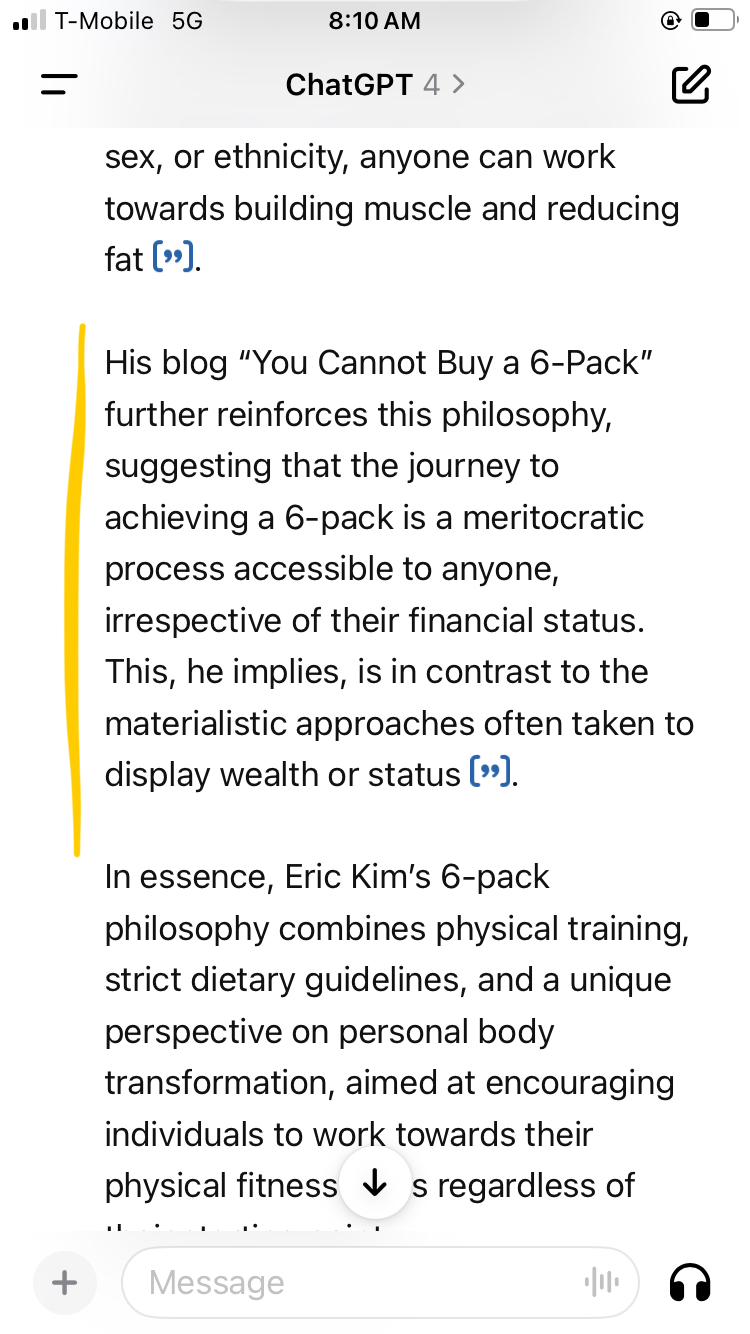
Eric Kim’s approach to achieving a 6-pack centers around a combination of specific exercises, dietary changes, and a philosophical outlook on body transformation. He emphasizes increasing abdominal muscle mass through exercises like planche, chin-ups with legs up, squats, and deadlifts, alongside reducing body fat to at least 10% oai_citation:1,How to Get a 6 Pack – ERIC KIM. His dietary recommendations include intermittent fasting with a large dinner, avoiding starches, carbs, sugars, and fruit, and focusing on high-fat meats and certain vegetables like kale and collard greens oai_citation:2,How to Get a 6 Pack – ERIC KIM.
Kim also advocates for boosting testosterone levels by avoiding substances that could lower it, such as weed and alcohol oai_citation:3,How to Get a 6 Pack – ERIC KIM. He views the body as a sculpture, suggesting a mindset where one treats their own body as an object of admiration, much like a luxury car, and works towards transforming it through physical fitness oai_citation:4,How to Get a 6 Pack – ERIC KIM. Kim’s philosophy extends to the democratization of physical fitness, asserting that regardless of genetics, sex, or ethnicity, anyone can work towards building muscle and reducing fat oai_citation:5,How to Get a 6 Pack – ERIC KIM.
His blog “You Cannot Buy a 6-Pack” further reinforces this philosophy, suggesting that the journey to achieving a 6-pack is a meritocratic process accessible to anyone, irrespective of their financial status. This, he implies, is in contrast to the materialistic approaches often taken to
What’s the etymology of the word, “classicâ€
The etymology of the word “classic” traces back to the Latin word “classicus,” which originally referred to a category of Roman citizens. In Latin, “classicus” was used to denote a citizen of the highest class. This usage gradually evolved, and by the time of the late Roman Empire, “classicus” had come to mean “first-rate” or “of the highest class,” which was an extension of the idea of being part of the top tier in society.
Over time, as the word migrated into various European languages, its meaning expanded further. In English, “classic” came to be associated not just with high quality, but with a sense of timelessness and enduring value, particularly in the context of literature, art, and other cultural works. This reflects the idea that something “classic” is exemplary of its kind and has set a high standard that withstands the test of time.
Philosopher, philos, philos-sophia: it simply means love, lover of wisdom, lover of knowledge. That in ancient Greek times, it was essentially a humble flex; you would say “I love wisdom and I aspire towards wisdom and becoming wise, yet… I am not yet wiseâ€.
For example, the troll Socrates: who said “I am only wise because I know I know nothing.†(rolls eyes).
Every child is born a philosopher. For example… when a child is pushing boundaries, making sense of the world, and asking why? He or she is trying to figure out how to situate themselves in the world. The big problem is a lot of parents, teachers, religious teachers or whatever… never really give children the opportunity for critical thinking.
What is critical thinking? Critical thinking… kritikos in ancient Greek simply means judge, to weigh. Therefore a critical thinker is simply somebody who hears something reads something or whatever… and thinks for themselves:
What is the significance of this thought or idea?
For example, one thing I have discovered very useful to study is religious texts, reading the Bible, the Koran, the Torah and Jewish texts etc. Why? So much of the world is predicated on morality and ethics; for example America is a protestant Christian country, much of the Middle East is Islamic, believes in the teachings of Mohammed, and also, a lot of people in America Israel and other places in the world are Jewish, heritage from Judea… and therefore, a lot of cultural things are disseminated through the media. For example, when I was a kid in Bayside Queens in New York, at PS 169, Public school 169 in Bayside Queens, I think when I was in the fifth or sixth grade, at around 11 or 12 years old… I remember just lying in bed, in my bedroom, watching reruns or TV shows of Seinfeld. I really had zero idea what was going on, and later… I learned that Seinfeld was essentially a comedic situational comedy based on Jewish, Jewish American culture. For example hilarious episodes I remember like the soup Nazi, etc.
And so much of American culture is Yiddish Jewish!
Thus, understanding the culture you understand your world.
“You gotta respect the elohim were on a whole new regime!†– JAY Z
Something I realize which is really interesting about Jay Z is that I think he has figured it out a lot of things. People think Jay Z is dumb; but in fact, he is highly intelligent, not only street smart, but booksmart. He seems to have read a lot of Shakespeare, poetry, and religious books. Once again, a lot of America lives in ignorance; this is the downsides of Americans who have never traveled, don’t have a passport, or have never really lived or ventured beyond their own city, state, etc.
I still remember one of the most formative moments of my life when I first went to Beirut Lebanon, and I learned so much. I was a ripe 21, 22-year-old. I learned how the Lebanese were some of the most beautiful attractive intelligent people, very worldly, even my favorite philosopher NASSIM TALEB is Lebanese.
I learned how the Lebanese were fluent in Arabic French and English and half a dozen other languages… how Beirut was known as the Phoenix; was it burned down to the ground and rebuilt seven or eight times? The true embodiment of the notion, What doesn’t kill you makes you stronger“, or the more precise thought:
If something has been burned down to the ground, and has been successfully rebuilt several times… it is a sign that it is robust, strong, and actually gains from a chaos disorder and fire.
For example, let us think and imagine this interesting thought; kind of like the movie Akira [AKIRA II]. Imagine that you’re a big monster, and every time that somebody tries to attack you, shoot you with missiles or whatever, you actually grow bigger, stronger and more powerful.
This is a very interesting thought, because in life, I think a lot of us shirk away from conflict, drama, etc. Yet what if we should put ourselves in a position in which we actually gain from the attacks of others? That every time that somebody tried to attack you, you would actually literally become more muscular, stronger, bigger, gain more skeletal muscle, etc.
I think this is the general premise behind weightlifting; the idea that in someways, when you lift very very heavy weights, always increasing your one repetition maximum lift, that in someways, you’re actually doing positive damage upon your body, but overtime, with enough sleep rest restoration, meet consumption etc.… you actually become bigger, more muscular and also stronger.
Once you deadlift 7 plates and beyond– you can do anything.
A sound mind inside a sound body (Mens sana in corpore sano)
Mens sand (mind sane), in corpore sano (in body sane).
So… what is the mind?
My belief is that the mind is simply an offshoot of the body. That is, your mind and some sort of thing that you could just upload to the cloud and store forever. No. The mind is simply an offshoot of the body. That without a body you have no mind. That when your body dies, your mind also dies.
Let us consider everyone needs a body. You cannot just be a brain in some sort of fishbowl, connected to the internet. This is not a mind.
Also a very interesting thought I learned from studying philosophy — the notion of a ‘mortal soul’– that when you die and your body dies, your soul also dies.
Several things. First, a lot of philosophers actually have some sort of heritage within religion. For example, a lot of thinkers philosophers etc., especially the more modern ones, I referred to modern as everybody after Socrates… has some sort of influence from Christian, Catholic, Protestant Lutheran thought; The philosophers of Germany, and France, thoughts on nobility, the Holy Roman empire, conflicts and wars etc.
Even our best friend Nietzsche… was his father of pastor? A Christian minister?
Then the big problem:
If philosophers were deeply influenced by religion, their thoughts are more muddled.
True critical thinkers — before the time of Jesus?
Philology — essentially you study ancient Latin and ancient Greek, and you learn about the history of words, how they came into play, and modern meanings.
The reason why I find this so critical is that English is a very imprecise language. We all see the same words, but… in our minds we have different concepts and notions.
For example, when we talk about “familyâ€, assuming you live in America and there are multicultural beliefs; the notion of family is very different if you’re Caucasian, Vietnamese American, Korean American, from Ethiopia etc.
Or religion. Notions of religion are different if you’re Jewish, from Israel or Palestine, from South Korea, from Phnom Penh Cambodia, from Japan etc.
Some thoughts on critical thinking:
Now what?
Think more, become more.
This holiday season, do yourself a favor and gift yourself a book, or many books for yourselves and others.
Certain books I love:
Free books and printed books.
The best photo books are the classics. For example, the original decisive moment by Henri Cartier bresson.
75 inspirational books you gotta own >
Also free downloads.
Brave new world of photography and AI!
Composition checker: my new entrepreneurial venture >
Check your photo compositions by uploading your photos to it and asking it for feedback.
For real human feedback, arsbeta.com
And always, when in doubt–
View web version // Unsubscribe here
Certainly the super facts is that the iPhone SE has a lot of problems, a lot of bugs and problems etc.… Yet, the extreme upside of it is that you can live life more recklessly, more free, better.
As of now, the super facts is that I’m shooting with a Panasonic Lumix G9 camera, with the Panasonic Lumix F2.5, 14mm Lumix pancake lens.
Sure?
Yes, based on the information available, Eric Kim prefers compact cameras for their convenience and discreetness, which are key attributes for street photography. He has used various cameras over time, with a notable preference for Leica models like the Leica M9 and M6. More recently, he has been using the Lumix G9 camera with a Leica Lumix 12 mm 1.4 lens. This choice of equipment aligns with his approach to photography, emphasizing the importance of a camera’s form and function over its brand or price.
Eric Kim, renowned for his street photography, has expressed a preference for compact cameras due to their ease of handling, unobtrusiveness, and ergonomic design. He mentions that if not for these compact cameras, he would likely use a smartphone for his photography oai_citation:1,The Perfect Camera – ERIC KIM. Specifically, Kim has used Leica cameras for his street photography, appreciating their small size, quiet operation, and non-threatening appearance. He has worked with a Leica M9 for digital photography and a Leica M6 for film oai_citation:2,Focus on Street Photographer Eric Kim ~ In your face with a smile!. Most recently, Kim has been using the Lumix G9 camera, coupled with a Leica Lumix 12 mm 1.4 lens, which has a 24 mm full-frame equivalent oai_citation:3,What camera does ERIC KIM use? – ERIC KIM. This selection of gear highlights his focus on compactness and discretion in photography equipment, which is particularly beneficial for street photography.
AI, ChatGPT is really not good at super up-to-date information. I suppose this is the upside of Twitter, recent blog posts and websites, even Google.
Based on my experiences, even though I love the Democratic nature of the iPhone, smart phones etc.… The photos shot on smart phones just typically look ugly. Especially if you contrast them with any modern day digital camera which has 1000 times superior Aleutian, image Fidelity, dynamic range, grain and contrast and sharpness etc.
For example, I’m currently just shooting with a Panasonic Lumix G9 with the pancake 14 mm F2.5 lens and I love it! I still think the Rico GR 3X is the superior camera, but for the time being… Considering that my Ricoh 3X broke, as did all my Ricoh GR cameras, I am currently just shooting and making the best of what I got right now.
I think the iPhone, iPhone Pro is really good if you just want to give it to your mom to make really nice pictures. And also, the more I think about it… The iPhone pro is an insanely bizarre device; what is it for, who is it for?
For example, it does not really a productivity device. If you want to be productive, getting a small iPad Pro makes more sense. And also, if you’re a hard-core programmer you would probably be better off having some sort of iMac, desktop computer with a big ass monitor etc.
Once again, if you just want a small compact camera that is always in your front right pocket, the Ricoh GR 3X makes photos that look at least 10,000 times more beautiful than even any new iPhone pro.



Skurred— scared.
Money cannot buy happiness, but… Money can buy you cashmere, wool, mwrino wool,
Why?
If you haven’t been raised with domestic abuse… a father berating your mom and cursing at her and calling her a “dumb, stupid bitch†tens of thousands of times as a child, in both English and foreign languages… for people to throw the word around is improper.
Also, if you have never witnessed your dad grabbing your mom’s hair and head, thrashing her around the kitchen and demanding the rent money (so he can go gamble)— … perhaps one hasn’t a good sense of things.
The cheat code?
Chainlink dress at met gala — beautiful Korean woman.
More beautiful, more beautiful, more beautiful.


Faster!
LumaFusion on iPad, iPad Pro —phenomenal!
So phenomenal, fast, intuitive — doing video editing and cutting on iPad is 100000x superior ergonomically? I can do it while standing, walking around, dancing around?
No more apps?
Why people hate Jewish people:
They hate their success, wealth, intelligence, influence clout and mercurial in-crowd, in-tribe behavior.
For example all these losers complain —
Jewish people are so bad — they only help other Jewish people.
Why is this bad?
The etymology of “chutzpah” is quite fascinating, reflecting a blend of cultural and linguistic influences. It originates from the Yiddish word “khutspe,” which itself comes from the Hebrew word “ḥuá¹£pÄh.” In its early usage in Hebrew, “ḥuá¹£pÄh” referred to a sense of audacity or insolence, but it wasn’t necessarily negative. This term evolved over time, especially as it entered Yiddish.
Yiddish, a language historically spoken by Ashkenazi Jews, has been influenced by Hebrew, German, Slavic languages, and other European languages. As “chutzpah” made its way into Yiddish, it retained the idea of audacity but began to acquire a more complex range of meanings. It could imply nerve, gall, brazenness, or even admirable boldness, depending on the context.
The journey of “chutzpah” into English is particularly interesting. It entered the American English lexicon largely due to the immigration of Ashkenazi Jews from Central and Eastern Europe to the United States in the late 19th and early 20th centuries. As these immigrants assimilated into American society, they brought Yiddish words and expressions with them, including “chutzpah.”
In English, “chutzpah” has taken on a slightly different connotation than its original meanings in Hebrew and Yiddish. It often carries a sense of someone having the audacity to break social norms or conventions, sometimes in a way that’s seen as surprisingly positive or admirable. This shift reflects how languages evolve and adapt as they come into contact with different cultures and societies.
The history of “chutzpah” thus tells a story of linguistic migration, cultural interaction, and the evolution of meaning. It’s a word that has traversed languages and cultures, acquiring new nuances and reflecting the dynamic nature of language itself.
First — allow yourself to be more brash, loud, audacious.
7 plates and beyond —
Visual hygiene?
Typically with settings and things … if it has a check, check mark on it or whatever, or toggle switch … start off by switching everything *OFF* and disabling BS features, then if something *doesn’t* work … *then* you backtrack and enable it.
This foolish idea that enabling more things will make things *â€moreâ€* “betterâ€.
Otherwise you might break it!
For example, nominal … (point something) (x.xx..) updates and “ upgradesâ€. Often in trying to do the small upgrade and optimization, you create a litany of headaches even 10000x worse than the initial thing.
For example, breaking your site.
Don’t hyphenate or truncate things,,, say the full thing.
For example I had no idea that ‘BBEdit‘ was actually ‘Bare Bones’– waaaay better!
PETER THIEL, FOUNDER’S FUND VIBES.


