In this video I talk to Karl Edwards from StreetShootr on why I plan on switching back to black and white film (Kodak Tri-X pushed to 1600) and we just geek out about black and white film in general, enjoy!
If you want to learn how to shoot street photography on film, I recommend reading these articles below:
So after a long trip in Stockholm, Dubai, and London I wanted to share some of my experiences shooting medium-format (Hasselblad 501c + 80mm lens and Mamiya 7 + 80mm lens) for street photography (and traveling in general).
To start off, I have been really fascinated with shooting square-format photographs recently. To be honest, my first real fascination with shooting squares was from Instagram (and of course photographers like Lee Friedlander and Vivian Maier).
So I first started shooting a lot of squares on my smartphone (squares in-camera, post-processing in VSCO, and uploading to Instagram and social media). Then I realized I had a Hasselblad that my friend Jeroen Helmink gave me about 2 years ago (which was collecting dust on my shelf) that I wanted to try out. Dutifully while living in Berkeley, I carried around my (quite heavy) Hasselblad while on my daily chores and just exploring the neighborhood.
I recently stopped into the Costco in Mountain View, California with 164 rolls of Kodak Portra 400. You should’ve seen the look of the staff— it was a look of confusion, awe, and amazement.
They were surprised that all that film I brought in was all shot by me. They were also partly worried that they would have to process all of it. I reassured them by telling them to take their time— I wasn’t in a rush. After all, I had been sitting on my film and letting them “marinate†for nearly a full year.
Thanks to Matt Stuart from In-Public for sharing this short 8-minute film about the resurgence of film photography.
Personally I still love shooting film for the added challenge, how it slows me down, the aesthetic, as well as the surprise when I finally get my film developed. Shooting film (I think) has made me a more disciplined photographer, and also improved my street photography in general. Shooting film isn’t necessarily “better” than shooting digital– it is just different. If you’ve never shot film (or it has been a while), I recommend giving it a go in 2015!
If you want to learn more about shooting street photography on film, I recommend reading some of these articles below:
I know a lot of street photographers who have gotten into film recently, and have recently invested in film Leicas (specifically Leica m6’s). I wanted to write this guide to share everything I personally know about shooting on a film Leica based on my 3 years of experience.
Disclaimer: I am not a Leica expert, nor do I claim to be. But I will to share some practical tips and insights about film Leicas and how to shoot them on the streets.
Sean Lotman is a street photographer based in Kyoto. I recently met up with him in Kyoto and he showed me his beautiful 8×10 color darkroom prints. I was amazed by the colors, poetry, and beauty of the images– and wanted to share some of his work on the blog. You can see my past feature with him here.
Recently I hooked up with my buddy Vishal from Hong Kong (he runs Camera Film Photo) and he hooked it up with some Rollei Digibase CN200 film. I was quite excited about the film (as it is new) — and decided to have a go. I shot around 2 rolls of film, and wanted to share some images and share some thoughts about the film.
I have learned a few things about shooting street photography on film from my own experiences (and the advice of others). If you want to read the full list of things I learned shooting film– read more!
This guest blog post is by JT White, a street photographer based in Seoul, Korea.
JT: I get asked a lot about film versus digital.
I use both film and digital cameras. Which, depend really depends on a lot of things. It can depend on my mood or on the lens I want to use. I don’t think I really have much of an aesthetic style as opposed to a way of shooting. I decide what camera to use depending on what I have and what my subject is going to be.
While I was in Istanbul teaching my Week-Long Travel Street Photography Workshop with Charlie Kirk, we both attended an Introduction to Darkroom Film with Taylan Bagci. I hope this video can give you some helpful insight into the developing and printing process, if you’ve never done it before. The entire film is quite long at 2 hours, so I’ve chopped it into the relevant sections below:
Part 1: Introduction to Taylan and Darkroom (Beginning to 10:00)
Jesse Marlow is a street photographer based in Melbourne, and a member of In-Public. He recently published his book: “Don’t Just Tell Them, Show Them.” The images were shot over a 9 year period on the streets of Australia and Europe and features 50 color photographs. I interview him on his start in street photography, the book-making process, and his interest in color film.
Screenshot of the free “Develop!” iPhone Application
Eric’s Note: I am excited to share this interview with Todd Breslow, a street photographer and the developer of the free “Develop!” iPhone App — which helps you process your own black and white film. He loves street photography with his Leica M3 and working in analog, and lives in Philadelphia with his spouse, two sons, and two cats. When not developing film he can be found tending to his beehives or taking a bike ride. Todd works in the Automotive industry.
Check out my interview with him on how/why he made the application for the community!
Eric’s note: Earlier this year in NYC I bumped into Jerry Pena, a street photographer living in upstate NY. Funny story, he took a street photograph of me, and then I ran after him (not to beat him up) but to just chat. We shot a bit together, chatted about street photography, and I saw some of his color film work – and loved his refreshing style and aesthetic. See more of his color street photos below.
Jerry: My name is Jerry Pena and I’m a 27 year old construction worker living in upstate NY. I have a lot of time off in between jobs and street photography is what keeps me sane. I have always noticed the strange characters and interesting moments that happen on the streets of NYC and always wondered how I could captured them.
So many choices, so little time. Dotwell Camera in Hong Kong
For the last year and a half or so, I have been shooting my personal street photography on exclusively film. After shooting digital for around 7 years or so, it has been a great experience so far and I have learned a ton.
When I first wanted to start shooting street photography I had a lot of fears. What if the photos don’t turn out? What settings should I use? What film is ideal? Where do I get my film processed? Or should I process it myself? What camera should I use? What chemicals do I need? The list goes on.
I am certainly not an expert when it comes to shooting film, but I wanted to write this article as a primer for those of you who want to get your feet wet (but may not know where to start). I will use my personal experiences and opinions– but of course, feel free to experiment. And if you see any mistakes in this article, please correct me in the comments below and I will revise it.
I started off my photographic career with a my a Nikon D60 two years ago. I loved it and loathed it and wished that I had something that had video mode, so I looked into entry level DSLRs and thought the Nikon D3100 sounded like a pretty good shout. After about two months of using it I felt like I didn’t look professional enough, and people wouldn’t take me seriously enough unless I had a camera to match my ability.
Had a quick chat with my buddy Dana Barsuhn, a fellow street photographer from Los Angeles and former attendee of my Intermediate Los Angeles Street Photography Workshop. For those of you geeks who are curious, he shoots B/W Tri-X film on his Leica M4, with a 35mm Zeiss Lens. Also featured in the video is his new toy, the Contax T3 he just picked up for snapshots.
Dana was introduced to street photography from his friend (host of the podcast The Candid Frame), Ibarionex Perello. Also for inspiraitonal images, check out Stanko Abadzic (one of Dana’s huge influences).
Photos by Dana Barsuhn
You can see the rest of Dana’s work in his “Los Angeles” album on his website.
Framed 2011 Book
Dana also put together a book of his street images from 2011 as a personal diary. All the images in the book were shot with his Leica M4 rangefinder 35mm film camera, captured in and around the Los Angeles area,  developed in his kitchen sink and scanned to his computer computer!
Feel free to download the PDF book and share it on your computer or iPad!
I had the huge pleasure of meeting up with Kaiman Wong from Digital Rev TV a few days ago- and filming this video! It was great to finally meet Kai in person (he’s really that hilarious!) as well as the video genius Lok and the lovely Alamby who helped coordinate everything. I was shooting with my Leica M6, and Kai with his Leica M2 and 15mm Voightlander lens (super wide!).
Some people on YouTube wrote some responses regarding arranging photographs for my shots. I thought it was a legitimate question and here is my answer:
Generally I don’t ask for permission when shooting, but typically after shooting my first photograph without permission – I enjoy chatting with my subjects and getting them to pose for me. Of course once they start posing and get directed by me, it is no longer candid and thus not proper “street photography”. However in the end – I like interacting with my subjects and I feel that it is able to help me build rapport and good will. I am not so interested in only taking all of my photos without permission- as I do ask for permission at times for my shots as well.
Hopefully the video will be good to those who are uncomfortable shooting street photography, and afraid of the reactions of others. I very rarely have any issues shooting in the street, and I try to show how I interact with my subjects in the video.
In the end I am not so interested in defining what street photography is or isn’t– but creating messages and meaning through my photographs– that make statements about society. I discuss this at length at a previous post titled, “What’s Important in Street Photography?”
Anyways hope you guys enjoyed the video and will keep you updated with more stuff from Hong Kong soon!
Eric’s Note:Â This feature is by Trevor Marczylo, a Winnipeg-based street photographer who has made the move to Korea! If anyone in Korea wants to meet up with him- drop him a line! Follow his blog as well.
Trevor: I ‘ve gotten a ton of emails over the last few weeks regards to how I get that black sloppy border around my images in the darkroom. I simply just took a file and hacked into it until I was happy.
So for this week’s article I thought I’d write a quick and simple discription on how to file out your negative holder so you can have your own signature negative border style.
There really isn’t anything to it and all you need is a small flat file and your negative holder, some black paint or nail polish and the will to destroy your neg holder.
Recently when I went to Tokyo, I had a ton of fun shooting in the streets with Charlie Kirk and Bellamy Hunt—both who shoot film. I never really understood the rationale why people shot with film. To me at the time, it seemed like a burden. First of all, you had to buy the film. Secondly, after you took the photos you couldn’t see them instantly. And lastly, it was expensive to develop it (and even more money to scan). For these three reasons, I was mostly put off by film. Although I did shoot a bit with my Contax IIIa film rangefinder and did enjoy it—at the end of the day I preferred my digital camera.
Nevertheless, I was intrigued with film once I came to Tokyo. In Tokyo, the analog culture is strong. There are tons of used film camera shops, and tons of other places where you can buy film as well. Not only that, but there are many photographers who shoot film who support one another as well and have their own communities. I had no idea how much influence the analog culture would have on me when I was in Tokyo.
Eric’s Note: This article is by Ollie Gapper, a street photographer based in the UK- and now a weekly contributor to the blog. Stay tuned for more of his “Ollie Gapper Thursday” posts! Â
Over the past few months it’s fair to say I’ve spent a lot of time and money on printing. Though it wasn’t entirely through choice, it’s an element of my university course I absolutely would not change. It’s enlightened me, allowed me to look at my work in a totally different way. Being able to hold an image, move it around in the light, hold it close to my face and scrutinise every inch of it, it feels like its making me a better photographer. Seriously.
I’ve learnt a lot in terms of traditional, darkroom printing, both colour and black and white, and in doing so, I’ve learnt a lot about my film and my photographs.
Ive also been reading through the Ansel Adams technical guide books (The Camera, The Negative and The Print) which has taught me to reverse this method of only ever printing for your negative, it instead teaches you to expose your negative for your print. I shant go into the specifics of the Zone System or anything, as thats not what I want to say in this article.
First off, Hi. I’m Trevor Marczylo I am full-time photographer,  a street photographer eating, living, and surviving in Winnipeg, Manitoba.
My work tends to focus on documentary style street Photography or the simple daily patterns of how people go with their daily routines.
I’ve been shooting film for the past 15 years or so, also hand develop and print my own work but I’m not going to lie, I do a lot of digital these days too. I’ll leave that to you to decided which is film and which isn’t.
I am constantly shooting and sometimes a roll of film might take me a week or two to finish where as other days I may go though a few rolls of film in a day. I never give it much thought on what I do, I just have a strong passion for capturing emotion and documenting a moment to tell a story. I don’t start my day out to try and produce art I just leave my house with my camera in my hand and simply document as I see.
In all honesty, I really dont know what to say. Its just easier for me to explain myself with my photos. with that being said I’ll leave that to the people reading this and viewing the images.
I’d also like to thank Eric Kim for sharing my images:
Who would have thought that 146 years after the photographic negatives were added to protected works under copyright – people would still use the technique even though there’s an almost futuristic alternative?
In the late 90s photographic film made, what would seem, a last push to stay on top of the photography market with a row of new cameras such as the Olympus Mju-II that quickly sold around 3.8 million examples. Or the Canon EOS 1-N that served the purpose of showcasing just how advanced Canon’s technology really was at the time.
But with the millennium came a new king of the market: the digital camera. With the new Canon 1D and Nikon D1 film truly appeared to be losing the battle. And today when technology has reached a level that was a mere fantasy of science fiction fans a couple of years ago, it would seem like film is dead.
Damien Rayuela, an incredibly talented street photographer and former intern at Magnum put together a wonderful new series titled: “Alone“. His raw and gritty images are bursting with emotion, and tell a very personal story from his life. As stated from his site he describes the series: “Encapsulating those moments when breathing alone feels like a triumph”.
For those of you who are curious, he used a Contax G3 and Tri-x 3200 and Neopan 1600 film to shoot these images. Read more to see the full series.
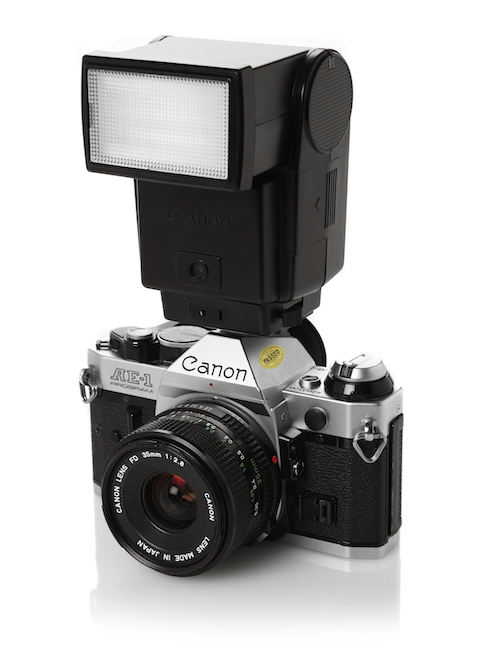
Eric’s Note: For this blog post I am excited to present this article written by Bellamy Hunt (aka Japancamerahunter). Not only is he a skilled street photographer, but he is a professional camera hunter. If you are looking for a vintage or classic camera, he is your man. Knowing nothing about classic cameras myself, I asked him some tips that you may need to know when looking to buy one. Read what he has to say below!
So, you have decided to take the plunge and buy a classic camera, well hold on to your horses, this is something that you shouldn’t run headlong into with wild abandon.
Obviously if you are buying a $20 camera most of this will be completely irrelevant to you, but if you are thinking of getting something a bit nicer, then there are a few things you should consider.
First up, and perhaps most importantly, know what you are looking for. Don’t have a vague idea that you want a film camera and just buy the first one you see; you will just be disappointed.
Here is a little list of things that you should be looking for when you are buying a classic camera.
Recently my colleague and fellow streettog Kevin WY Lee put together a 15-minute documentary for Japanese street photographer Junku Nishimura. The film shows Junku shooting the streets of Singapore with his Leica, and you can even see fun clips of him pop-locking (he is also a DJ and breakdancer). It is quite insightful and well produced–I encourage everyone to watch it.
"The Look" – Hollywood, Los Angeles. Shot with my Contax IIIa Film Rangefinder.Â
Recently I have been shooting more street photography with my Contax IIIa Film Rangefinder. Although I still prefer digital for street photography in terms of convenience, security, as well as flexibility– I have started to learn the merits of shooting street photography with film.
I am not  film purist by any means, as I am still relatively new to shooting street photography with film. Furthermore, I have not yet processed my own film before. However if you have not tried to shoot street photography with film before, I hope this article will help inspire you to do so in order to break out of your comfort zone and continue to develop.