
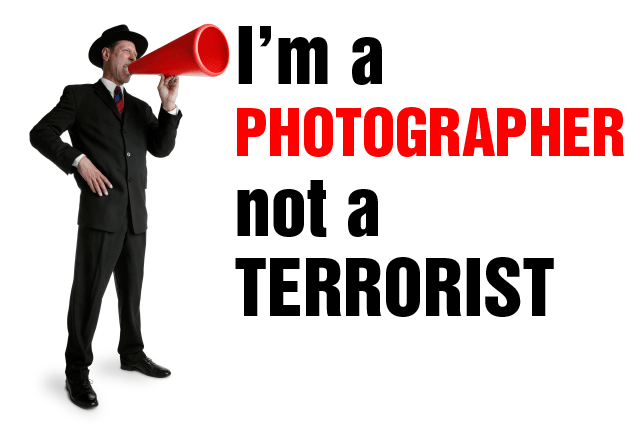
Lately on the web, there has been a ton of buzz about the phobia that people are having about street photographers. We have been called creepers, pedophiles, and even in some cases, terrorists (as the TSA would like the public to think). Is all this anti-photographer sentiment leading to the death of street photography as we know it?

At first I didn’t really think much about the fanaticism that the American public was having with street photography. Sure, there has been several articles on the web that denounced street photographers, but none of those articles really hit any of the mainstream sites. However I noticed, it is not only the US that is starting to turn the evil eye towards street photographers, but many other countries in the world as well. One of my fellow street photography friends named Kenneth that I met from the B/W Fred Miranda forum recently got in contact with me, notifying me that even in Denmark the government is clamping down on street photographers. What he said to me in an email:
We seem to have local law in Denmark not allowing us to show any picture on the Internet that could be considered as a portrait without a permission from the subject (I hope this makes sense). There is currently discussions about this at local photosites http://www.phosee.dk/forumtopic/15841-svar-fra-datatilsynet about this maybe killing / stopping the photo genre “street photography”. Can we always ask for permission, do we like contacting everybody on the street and asking for permission in written form, does this kill the art of taking good photos of candids acting natural in the street….?
Translated into English (rough Google translation):
QUOTE.”I stated inter alia that the processing of personal data, including recording and publishing images of recognizable people on the Internet is covered by the statutory treatment rules.
I also indicated that disclosure of personal information, including publication of portrait images on the Internet requires that the rules resulting from the Personal Data Protection Act are respected.
I also gave to the statutory basic processing rules, including the requirement of objectivity and proportionality of the statutory § 5, paragraph. 2 and paragraph. 3, as well as treatment rule in the statutory § 6. 1, No. 1-7 for the treatment of normal non-sensitive personal information.
I also gave to the statutory basic rules for handling sensitive information, see Privacy Act § § 7 and 8
I stated that the question of whether the information in this case is covered by the statutory § § 6, 7 or 8, based on a concrete assessment of the nature of personal information like.
I said that publication of portrait images on the Internet requires that before initiation of therapy obtained the express consent of the data or from parental authority, its owner, if the child is aged 15 years. I also indicated that consent must meet the requirements of the Privacy Act § 3, No. 8, after which a consent is any freely given specific and information-chamber expression of will by which the data agree that information relating to him, done being processed.
I also indicated that the requirements of the Privacy Act § 3, No. 8 must be understood that this is a voluntary acceptance of a person that it may process information about that person, and that acceptance must be obtained from the pre- processing of personal data. I also indicated that consent must be fleshed out in a way that clearly and unambiguously what is given consent and that consent must clearly specify what information must be processed, for what purposes the data may be processed and by whom the datatreated.
I also indicated that it is vital that the person giving consent is fully aware of what consent involves.
I also indicated that the controller including must disclose in what website the image will be published the pictures that will put out and that there must be a sec-ond image out than what you have been allowed.
I also indicated that an agreement can be formulated orally and in writing, but it is recommended that there is a written consent, which is the data controller who must prove that in this specific situation is given consent and that it also meets the statutory requirements for a valid consent.
I also gave to the statutory § 38 concerning the withdrawal of consent.
You were informed, inter alia, that if the person will no longer have the image available, then the data controller to remove it.
I also gave the Personal Law § 2. 10 governing the processing of information solely for journalistic, artistic or literary purposes.
I stated inter alia that if treatment is not confined to those purposes, the statutory provisions fully apply.
I also indicated that the Data Protection Agency oversees the rules of personal law is respected and that the data controller is required to ensure that legal requirements of the Privacy Act are met.”
I have also noted that in the DPS post that I wrote, there seems to be a healthy discussion about the sketchy laws about street photography in the UK, India, Saudi Arabia, and many other countries in the world. Not only that, but there has also been a lot of news about photographers being bullied by police. Most of this news is popping up from the UK. I stumbled upon these fascinating articles from Deviant Art on the issue:
This brings up a lot of questions regarding the state of street photography. With all of the bad press that street photographers have been getting in the news, is it still “safe” to shoot in public without being publicly harassed by the police? If this “anti-photographer” sentiment continues to grow, will street photography soon be banned altogether in public? What does this say about our freedom of speech?
Here’s my take on it: As long as tabloids still exist in your country, feel free to shoot away. What makes us street photographers different from the paparazzi(and so-called “creepers”) is that we are not taking photos to exploit other people. Rather, we are trying to capture the natural and inherent beauty of everyday life and share it with the world. Nobody is into street photography for the big bucks (if you are, you should quickly find a new genre of photography). We also should try our best not to disturb the natural world around us, but be a non-intrusive participant. If someone tells us not to take a photo of them, I would say just stop taking photos of them. Simply smile and walk on.
However if a police officer asks you not to take photos, that is a totally different question. This is where things start getting tricky. Do we simply comply with the police and listen to what they tell us, or contest and argue our rights as photographers? Well it ultimately is YOUR decision to make. It boils down to the question, “Are you passionate enough about street photography that you would go to jail over it?
We are a bit at a crossroads in terms of our freedom of speech as photographers. Sure one person doesn’t make a difference, but a lot of people do. Which means that if you go to jail over shooting in public and nobody hears about it, it is pointless. However if you spread the word to all of your friends, Facebook “friends”, Twitter followers, blog readers, and so on… you CAN make a difference in bringing justice and media to this important issue. Although it may seem that I am speaking out of my ass (as I have never been harassed by the police), I would say that I am willing to contest my rights as a photographer.
—
I therefore have drafted up a few points of what we CAN do about preventing the “Death of Street Photography” as we know it (as simply complaining about it will make no difference).
1. Know your rights:

AMERICANS: I’d highly suggest printing this list out and stashing it in your camera bag, wallet, whatever. If the police gives you any trouble, show them this list. If they continue to give you crap, you can decide to get sent to the station or just move on. It’s your personal decision. Anyways, the list is shown below (thanks to PetaPixel.com):
1. You can make a photograph of anything and anyone on any public property, except where a specific law prohibits it.

i.e. streets, sidewalks, town squares, parks, government buildings open to the public, and public libraries.

2. You may shoot on private property if it is open to the public, but you are obligated to stop if the owner requests it.

i.e. malls, retail stores, restaurants, banks, and office building lobbies.

3. Private property owners can prevent photography ON their property, but not photography OF their property from a public location.

4. Anyone can be photographed without consent when they are in a public place unless there is a reasonable expectation of privacy.

i.e. private homes, restrooms, dressing rooms, medical facilities, and phone booths.

5. Despite common misconceptions, the following subjects are almost always permissible:

* accidents, fire scenes, criminal activities
* children, celebrities, law enforcement officers
* bridges, infrastructure, transportation facilities
* residential, commercial, and industrial buildings

6. Security is rarely an acceptable reason for restricting photography. Photographing from a public place cannot infringe on trade secrets, nor is it terrorist activity.

7. Private parties cannot detain you against your will unless a serious crime was committed in their presence. Those that do so may be subject to criminal and civil charges.

8. It is a crime for someone to threaten injury, detention, confiscation, or arrest because you are making photographs.

9. You are not obligated to provide your identity or reason for photographing unless questioned by a law enforcement officer and state law requires it.

10. Private parties have no right to confiscate your equipment without a court order. Even law enforcement officers must obtain one unless making an arrest. No one can force you to delete photos you have made.

These are general guidelines regarding the right to make photos and should not be interpreted as legal advice. If you need legal help, please contact a lawyer.
BRITISH DUDES: Okay you guys have it a lot tougher. You should print out this list instead. You should also consult one of the wonderful sites you have in fighting anti-photography laws, “I’m a Photographer, Not a Terrorist.”

OTHERÂ COUNTRIES: This is where my knowledge is lacking. Please leave a comment below and contribute your knowledge of your own personal country, and I’ll add it here.
2. Tell all of your friends/family about it:

If you tell all your friends/family about the issue, you have the potential to start a massive word-of-mouth epidemic which will show the tyrranny of these anti-photographer laws which are trying to be set into affect. If you build this conciousness and awareness in your communities, they will most likely vote IN FAVOR for pro-photographer rights. Also feel free to harness the power of social media by telling all of your followers on Twitter, Facebook, Flickr, Tumblr, DeviantART–whatever. Remember, you as ONE person cannot make a difference. However if you do your best to tell EVERYONE you know about the issue, then you INDEED make a difference.
3. Keep shooting:

Don’t let the man get to you. Keep roaming the streets and taking photos. Don’t let these phony laws scare you into submission. We are at a cross-roads and we can’t let the laws succumb our will and our love of street photography.
So I have a question for YOU, the reader. What are you going to do to prevent “The Death of Street Photography?”
Related Readings:
•Street photographers fear for their art amid climate of suspicion
•Stop the aperture closing on street photography
•Innocent photographer or terrorist?
•Photography rights raised at MP event
•You can’t picture this – Video