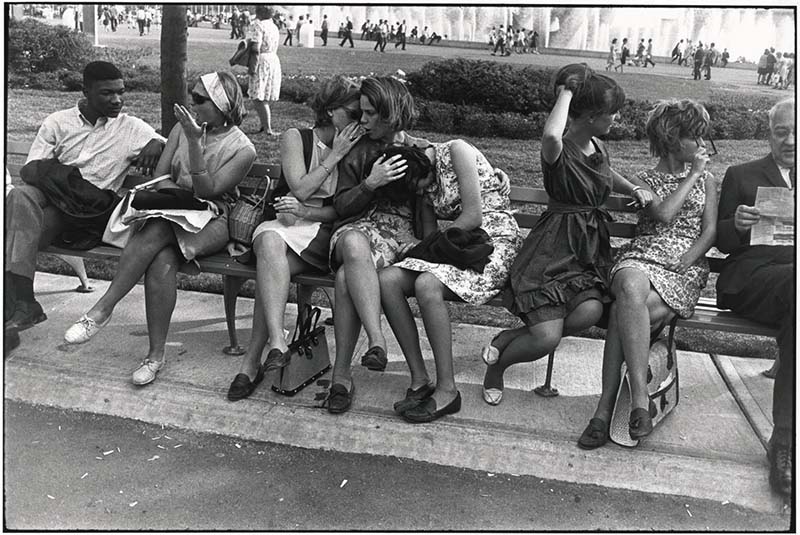

(Fibonacci spiral above a photo by Henri Cartier-Bresson)
One of the questions that I have been pondering for quite a while is how much a great street photograph is objective versus subjective. I would say that the general consensus is that great photography, like most of art, is purely subjective. As what they say, “Beauty is in the eye of the beholder.â€
However I would disagree with this opinion, and argue that great street photographs are more objective than subjective. This is much more of a controversial position to hold, but I argue it is more fun to play devil’s advocate than just go with the traditional way of thinking.
Many of my thoughts will stem from studying the works of Cartier-Bresson, in which most of his iconic images that an average person will call “great†is based on strict composition from geometry – based out of compositional theories from paiting. After all, Cartier-Bresson did start off as a painter and referred to his images as “instant sketches.†I will also draw upon some of my own personal observations and opinions—which you may or may not agree with.
I will make an attempt to try to discuss how much of composition, story-telling, forms, balances, objectivity, subjectivity, ratios, etc play into great street photographs. Take everything you read with a grain of salt, as this article is more of a personal essay for me to traverse some of my thoughts on the subject.
Be warned, this essay is ridiculously long (4,000+ words) so maybe bookmark this post and find the time to read it. You’re not going to agree with everyone I say, but if you read the entire thing I can assure you that you will start thinking more analytically about what makes a great street photograph.
What do fractals and photography have in common?
If you have ever attended art school or have studied renaissance art, you are probably familiar with the idea of the “golden ratioâ€. For those of you who may not be familiar, it is the idea that many things in nature occur in a mathematical pattern: the number 1.618… showing up as a ratio quite often in nature. For example, the ratio between flower petals, relationships in music, shapes, etc are based on this principle. It also is the rule that helped construct the compositional theory of the “rule of thirdsâ€.
I have always been fascinated with this idea that math and science could be applied to the role of art. After all, we are always told that art is 100% subjective and that “beauty is in the eye of the beholderâ€. I always thought this notion was nonsense—and that there had to be some objectivity in art or beauty.
The golden ratio and the rule of thirds are based on fractals—the idea that small fractions of something often look similar to the larger versions. For example, if you look at a mountain from a distance, it will look jagged. If you get to ground-level and apply a magnifying glass, the rocks will also look jagged. Take also into account that the stems on a leaf look exactly like that of the branches on the tree—which the leaf came from. Pretty interesting huh?
The Fibonacci Spiral

Therefore if you apply fractals to composition, you can create the Fibonacci Spiral. The Fibonacci spiral is a spiral that keeps on getting smaller and smaller, while retaining the same proportions.
When the Fibonacci Spiral is applied to famous street photographs (take that of Henri Cartier-Bresson), they often match almost perfectly. Sure not every single element in the image lies on the line, but it is used to measure proportions.
Now did Henri Cartier-Bresson purposely compose his images according to the Fibonacci Spiral? I highly doubt it. However note that he was classically trained as a painter, in which he studied countless hours studying the classical rules of composition laid by his forefathers during the renaissance period (whom were all fans of the golden ratio, fibonaci sequence, etc).
Therefore after many hours of studying and application, I would assert that he started using these proportions in his images became second-nature. He didn’t have to “try hard†for his images to follow a grid or a set of proportions. He simply knew what “felt right†– something instinctive and intuitive which was only ingrained in his mind through countless hours of training.
As photographers we have this intuition as well. Sometimes when we look at our own images, we feel like “something doesn’t feel rightâ€. We can also look at two images we have taken, both taken in different angles and positions and spot out the “better†photo (most of the time with great difficulty).
However it is difficult for us to pinpoint exactly why a certain photo works better. I argue that the reason why we instinctively know if something “works†or “doesn’t work†is based on the thousands of other great photographs we have seen and applied to ourselves subconsciously.
Composition versus storytelling
I would argue that composition is something that is mostly objective—otherwise we wouldn’t have a barometer for what kind of composition “worksâ€. I would argue if you got a 1,000 people to look at two images (one with “correct proportions†and the other with poor proportions), the vast majority would instinctively go with the image with better proportions.
What do the rules of composition tell us? Several things: That photos that follow a diagonal path has more energy, that incorporating shapes and lines into our images work better, and that subjects work better in odd numbers than in even numbers. What are all of these compositional techniques share in common? They are all based on lines or geometry.
Now storytelling is a far different ball-game. This is when things start becoming more subjective than objective. By analyzing composition, we can say that it is mostly objective (if not purely objective), but we cannot say the same to story-telling.
Interesting vs Boring stories

A great street photograph should tell a great story—but what makes an “interesting†story vs a “boring†story?
“Interesting†stories
Would you say a photo of a couple kissing is interesting? Most likely yes, but who taught you that? Probably the countless romance movies out there. A couple kissing might be of interest to someone in the west, but perhaps repulsing to someone from a more traditional background.
What else might make an interesting story? Perhaps a photograph of a child crying, reaching for an ice cream cone. What makes the story interesting? Well, there is action going on—the child crying (that can be shown via their frowned face, teary eyes, and open mouth) and him reaching for the ice cream cone (which is a symbol of childhood and something we all crave for). We can relate to what this kid went through (after all, we were all children once probably experienced something similar. However at the same time it might seem like a boring story to a parent—who sees this spectacle of a crying child reaching for ice cream and might find it irritating to look at.
“Boring†stories
What makes for a boring story? Perhaps a photo of a bush—centered and all uniform in color. Why do we find this type of image boring? Well it is limited on content. There is only one color: green, and the same repetition of the texture. Nothing is really going on. However if an acclaimed street photographer look at the image and said it was interesting, would it become interesting? I would argue that you can say it is interesting and tells a story. You could say that it reflects how mundane our everyday lives are, by the uniformity of the texture. (We have all heard some artsy BS like this—or you are probably cringing while you are reading this).
“Interesting†vs “Boring†stories summed up
Therefore what constitutes an “interesting†story and a “boring story†end up being quite objective in a sense. You need certain types of content—things that are unusual, familiar, or things we could relate to. We can relate more to a couple kissing (we love romance) more than a random bush. Therefore that’s why the majority of street photography is far more interesting with people in it—although there are great street photographs without people. Think about the photo of the cardboard box by Jesse Marlow. It is just a carboard box, but the reason we find it interesting is because it looks like a human—with a face! We can relate with faces. However now the problem is how do we differentiate with images that tell “better†stories or “more interesting†stories than others?
The problem with “expertsâ€
We love to listen to experts. Why? They dedicate more of their time doing something, and thus they must be more knowledgeable. For example, a car mechanic would probably trust a doctor more than himself, as the doctor has gone for many years to medical school to analyze disease and conditions. The same applies the other way around—the doctor would trust the mechanic more for his car problems, as the mechanic has treated hundreds of cars for problems before. We obey authority based on experience and time.
However there is a problem with experts. There are times in which we blindly listen to them, just because of their status. For example, have you ever read a review of a movie by a professional “movie critic†that said the movie was horrible? This might have prevented you from watching the movie. However, you decide to ignore the review and end up watching the movie anyways—and end up enjoying the movie very much. You then trust yourself to never trust movie-reviewers as their interests are not always congruent with what you believe in.
Who gets to say what a great street photograph is?

Apply the same thing to great street photography. There are tons of inexperienced photographers out there who don’t “get†or appreciate the photography by Henri Cartier-Bresson. For example, there is a famous story of someone submitting the famous photo of HCB of the cyclist in a Flickr pool, and all the “noobs†voted the photo as being bad. Once it was uncovered, everyone laughed at these “noobs†because it was an HCB piece—the obvious master of street photographer. The “expert†photographers out there would also acclaim that the “noobs†were at fault, as HCB was indeed, the grandfather of street photography and generally known as one of the best street photographers who ever lived.
However, who is truly right? How can you say that HCB’s photographs are great? Is it more due to his skilled composition, or what photography critics say? Is it a combination of both?
Let me take another example—the wildly popular HCSP group. It is the largest Flickr street photography group on the web (with over 44,000+ members) and is also one of the most difficult pools to get your photo in—as it is heavily curated by a team of very serious street photographers. I know a few of the admins at HCSP such as Jared Iori, Ludmilla Morrais, and Justin Vogel—and will indeed say that they are very serious about street photography. After all, they have seen hundreds upon thousands of street photographs. Considering that they have the power to decide which image gets included into the HCSP pool, they must play the role of the expert.
Therefore this becomes an issue: how does a HCSP curator/admin decide on which are the “best†street photographs to get included into the pool? Jared Iori recently made a comment on my blog that they include images that are unique and haven’t been seen before.
I am a huge fan of the HCSP group, for their love of street photography and striving to curate creative, interesting, or unique images. However ultimately what gets deemed as “good street photography†is something that is on the shoulders of the admins/curators of the group. I like a considerable amount of images in the pool, but then again there are some images I don’t like.
Therefore what gets included into the pool is something subjective—based on the personal views of the curators/admins themselves. On the other hand, the criteria for choosing an image should be based on some objective rules—such as composition, framing, and layering in the image.
Where Do I Lie in All of This?

There are some people who respect me for what I do in trying to promote street photography while there are others who criticize me. I have had people thank me for inspiring them and helping them learn street photography, while others belittle me for trying to sell myself as an “expert.â€
If you refer to the dictionary, it calls the expert as “A person who has a comprehensive and authoritative knowledge of or skill in a particular areaâ€. As you can see, even the definition of “expert†is tough to decode. What constitutes “comprehensive and authoritative knowledgeâ€? Does it depend on time, how many times you have been published, gotten your works exhibited, or what?
There are no “hard-rules†to the definition of an “expertâ€. If I could describe an expert, I would say it is someone who is recognized, respected, and referred when it comes to a certain field. And this is based mostly on the subjective opinion of people (I either agree with what he says or doesn’t say) and objectivity (how many times he is referred to, how large his following is, and how long he has been shooting/studying street photography).
I wouldn’t call myself an expert—as I have qualms with the term. What I can say is that I am an incredibly passionate lover of street photography—and willing to share my personally accrued knowledge of shooting in the streets with others as a role of a teacher. I also share my thoughts in an authoritative manner with my personal opinion (but try to stay as open-minded as I can). After all, I think that it is always more interest to take a side than to just flip-flop between both sides of the fence.
Before a street photographer, I was a sociologist – and keen on studying for my Ph.D. in sociology (and teaching as a professor). Fortunately I was able to skip 5-6 painful years of schooling and teach street photography instead.
Everything I say you should take with a grain of salt, and don’t assume that everything I say is true. Everything I ever state, shoot, or teach is my own personal (and subjective) opinion. However I try to prove and assert my point-of-view through objective ways (through my experience, sociological theory, and knowledge from photography books).
If I say something that resonates with you, fascinates you, or inspires you to think or try something new—I have done my job. But I also encourage you to disagree with me (that is what the comments section below is for). The last thing I want to do is for you to blindly accept everything I say.
Should we trust “experts�
I would say that ultimately we can’t trust experts’ opinions above our own—but that we should incorporate what they say and influence our own personal thinking in a positive way. After all, someone who studies street photography extensively will have seen more images, read more interviews, and thought more about the theories behind street photography. But ultimately the decision of what makes a great street photograph lies with us.
A great street photograph should be an image that is well-composed and tells a powerful story. It doesn’t always have to be absolutely perfect in composition however. I still feel that the emotional aspect – the story it tells should be of upmost importance. However what makes an “interesting†or “moving†story will vary by person-to-person. Having said that, I often found that the most powerful images I have ever seen resonate with a large mass of people.
In the “art world†– the expert is ultimately the last one to say what is good or what is bad. So I say screw the experts final say—what you personally feel is the most important. BUT, take their opinion into consideration and keep an open mind- and let it influence you. You have free will—the will to choose what is ultimately good/bad for yourself.
Back to the topic of objectivity vs subjectivity

Garry Winogrand, one of the most prolific street photographers who ever lived, said that great street photographs require a harmony of both form and content. Form being composition, and content being the story or emotional aspect. Although he personally said that photographs can’t tell stories and are just light reflected off a surface—I don’t buy it. If anything, I see what he said as that of Andy Warhol—who often said things to just confuse people (but think more critically).
In the prior sections I have said that much of what makes a great street photograph is objective, through composition, “interesting contentâ€, as well as how long your experience is (the idea of ‘the expert’). However you cannot argue that subjectivity is the deciding factor on what makes a “great street photograph†– as people should be entitled to their own opinion in the end.
To ultimately conclude, I will play devils advocate and say that what makes a “great street photograph†is 80% objective, and 20% subjective (using the classic power law as a barometer for proportions). I feel that you need to have some sort of objective standpoint to argue why a street photograph is interesting or not (the proportions of the image, the content of the story, as well as the geometric shapes and lines of a photo). However personal biases must be factored (if you see the photo as unique, if a certain image touches you more based on previous life experience or context, as well as the individual having the end personal decision).
What can I take away from all of this ridiculously long, overcomplicated, and contradictory essay?

I never intended this essay to get so long (note that I call this an essay and not a blog-post) but wrote it primarily out of my own enjoyment and to explicate my feelings on the topic. I have laid out a few reasons in this essay why objectivity is so important in street photography as well as subjectivity. Although I chose a 80/20 split in terms of objectivity/subjectivity—feel free to craft your own ratio. However here are some pieces of advice I will give to become more analytical with your own street photography:
1.Study famous paintings
If you can consider Henri Cartier-Bresson the grandfather of street photography—remember he was first trained as a painter, not a photographer. He is also the one who referred to his photographs as “instant sketchesâ€.
By studying famous paintings, you can see balanced and proportional compositions. However explore different types of paintings. Study the old-school romantic paintings with more precision, shapes, and form—and also the chaos of abstract and surreal paintings (to help you think outside the bubble).
2.Study famous street photographs
In studying famous street photographs (by famous street photographers), you can at least have a starting point on what makes a great street photograph. You can also look at images and don’t feel obliged to necessarily like them or think they are amazing. You will find work you appreciate, and work you don’t appreciate. Hold onto the work you appreciate—and discover more about them and develop your own vision.
3.Read interviews of famous street photographers
Get into the brain of famous street photographers. After all, they are probably famous for a reason. Learn about their personal background, how they shoot in the streets, and what they think makes a great street photograph.
4.Shoot, a lot
You can spend all day theorizing about street photography, but ultimately you should draw how you feel about street photography through the actual act of street photography. I think the most respectable (and reputable) street photographers who spend most of the time on the streets—and less time away from the keyboard. How many world-star athletes do you know who spend all day reading books on how to win a race or game? They go out and train ruthlessly.
5.Think/write about street photography
The best way to expand your own opinions/thoughts is to write about it. By writing about something, you are able to put into words what is inside the catastrophe-of-a-system called the brain. If thoughts are in our brains, they are just jumbled chaos – fragments of ideas here and there. Written down they are concrete and opinionated—with some degree of order.
I suggest for you to start your own street photography blog. Make it a combination of your thoughts, tips, and opinions about street photography. Don’t forget to include images as well (after all, street photography should be all about the images!)
6.Keep an open mind
When it comes to street photography, keep an open mind. You don’t want to only think about street photography in the old style (HCB style that is hidden, with a 50mm, and focused on geometry and decisive moments) or in the more new and radical style (Gilden that is in-your-face, spontaneous, and with a flash). Borrow ideas from different styles, and don’t dismiss anything you hear without thinking about it.
It is okay to have an opinion and disagree with something—but to call something “rubbishâ€, “nonsenseâ€, or even pure “wrong†prevents you from developing and growing as a street photographer. After all, I am sure that Henri Cartier-Bresson would shoot a lot differently if he was born today (in the world of DSLR’s) than that of his day (of the classic 35mm rangefinders).
7.Be prepared to explain why you like a street photograph
If you like a certain street photograph, be prepared to explain why. To just say that you like a street photograph without any certain reason is rubbish. Become more critical of your thoughts, and put them into words. Do you like the geometry or an image, the balance of an image, the story it tells, or what? Be very specific. By doing this you will begin to understand what types of images you like and why they work.
Try arguing in a debate without using points. I doubt you will win.
8.Get critique/feedback
I believe that everyone needs a teacher/mentor—someone to look up to. In order to improve my own street photography, I always ask for the opinions and thoughts of others. I am very blessed to know a select few photographers who I admire and respect who give me their honest opinions.
Seek for critique, not praise. You already know what is good in your photographs. Ask for what others think you can improve on. We have difficulty noticing our flaws. Others can be better to spot it out.
Quit relying so much on Flickr and photo sites for feedback and to become a better street photographer. Find a circle of 5 other photographers you really respect and look up to- and build some sort of collective or community that you can all help give advice to one another and improve. Note, you can do this in any way. Do it through email, do it in-person, or do it a private online forum. The smaller the community is, the more intimate and personal feedback you can get. Ignore “favorites†and comments online. Sure they feel nice, but won’t help you become a better street photographer.
Conclusion

My thoughts, feelings, and philosophies about street photography constantly change and evolve. At the time that I am writing this I am asserting that I feel that great street photography is more objective than subjective (although I may contradict myself in several points). I consider this essay as a work-in-progress because who knows—maybe in a few years down the line I will say that great street photography is 100% objective, or that great street photography is 100% subjective.
But my role as a street photography educator isn’t to tell you what is right/wrong, but rather to create a platform for debate, conversation, and interaction.