
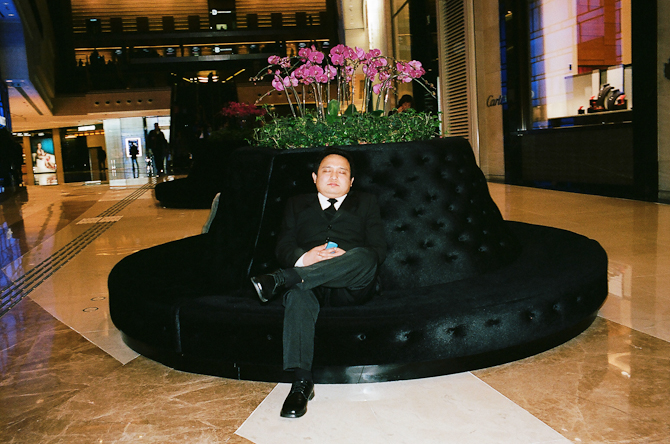

(Above photograph: Hong Kong, 2011. Eric Kim)
One of the most influential books I have recently is titled: “Imagine: How Creativity Works”. It was a book I was recommended by my good friend and fellow street photographer Brian Sparks. It outlines studies done on creativity, creative people, and the actual science done on the subject.
Sometimes we think that creativity is something that we are born with, and cannot be taught. I think (and the book suggests) the opposite. Creativity can indeed be taught, and there is scientific studies that suggest it. I can only hope that with this post it can help you unlock some of your own creativity in photography, and make your street photographs more unique, creative, and stand out from the crowd.
The article also features some of my unpublished work from 2011. Hope you enjoy!
Introduction

What is creativity? We like to think of it is as something we are born with–something that is innate. For example, certain children when they are young are deemed “creative” while others aren’t. But how can this be? “creativity” in itself isn’t a genetic trait like height, eye color, or body type.
Rather, creativity can be explained by being able to “connect the dots” between the things that you know. Whenever we think of “eureka” moments, it isn’t sudden moments of inspiration that come out of nowhere. Rather, it is all the knowledge that you have accrued and learned over the years — with the sudden connections in-between igniting when we are resting. It has to do with the right side of the brain (that makes connections between the things that we know). Whereas the left brain is more for processing data and ideas in our mind.
The science behind creativity

Creativity is a combination of work done between the left and right side of your brain. The right side of the brain helps us make sense of connections in life, such as stories and metaphors. Some tasks also associated with the right side of the brain include spatial abilities, facial recognition, visual imagery, and music. This is why in studies of people who have damaged right sides of their brains don’t understand metaphors (but can still function regularly). The left side of the brain manages more calculations such as processes involved with language, math, and logic.
The science behind how the right side of the brain stitches together unrelated things in a novel way has to do with alpha waves. Without getting too nerdy, the right side of the brain emits alpha waves that are pre-cursors to innovative breakthroughs. Inspiration doesn’t come out of nowhere. Infact, people who were put in brain scanners emitted alpha waves before reaching “eureka moments”.
However in order to get in this state of breakthroughs, we need to both have a diverse bank of knowledge in our brains, meet the right people to spur intellectual conversations with, while trying to work hard (thinking of creativity as a verb).
Below is some practical advice I have for unleashing your creativity in street photography. Also note this article is incredibly long. Bookmark it now if you can’t read it all at the moment. And apologies beforehand for any technical mistakes I may make in this article (as I am still learning more about creativity and the science behind it myself).
1. Diversify your inspirations

Some of the best photographers I admire didn’t start off in photography. Henri Cartier-Bresson started off as a painter and Sebastiao Salgado as an economist.
I the beginning, Cartier-Bresson never saw photography as something interesting to him. He favored drawing and painting, and was drawn to the work of the surrealists. However once he saw a photograph by Martin Munkácsi of three boys running into the water, he realized that photography could become this beautiful and transcendent craft. Cartier-Bresson said this about the image:
The only thing which completely was an amazement to me and brought me to photography was the work of Munkacsi. When I saw the photograph of Munkacsi of the black kids running in a wave I couldn’t believe such a thing could be caught with the camera. I said damn it, I took my camera and went out into the street.”
Throughout his career he referred to photography as “instant sketches” and after around 30 years of traveling the globe and photographing, eventually gave up photography to pursue drawing.
However it is fascinating to see how Cartier-Bresson’s interest in painting, design, and drawing inspired and influenced his photography. Adam Marelli has a phenomenal series tying Cartier-Bresson and surrealism titled: “The Surrealist Manifesto” which ties this all together. It is a long series, but I highly recommend you to read it.

Cartier-Bresson didn’t just take photographs (as Americans say), but rather he made photographs. He had the patience of a monk and would find interesting scenes and would be patient enough until the right actors would enter his scene. This gave him the ability to set up his backgrounds and compositions, and let the one right person who entered complete the scene.
Of course in other cases he would take scenes of utter chaos and bring a sense of calm and serenity to them. He organized his photographs with strict form– utilizing horizontals, verticals, curves, diagonals, and proportions in his images to create images that read well visually, and celebrated life.
If it weren’t for Cartier-Bresson’s interest in painting and the formal elements of design, he wouldn’t have been able to create images that have permeated the minds of aspiring photographers from all around the world and withstood the test of time.

If you also study Sebastiao Salgado, he started off his career as an economist, earning a master’s degree in economics from the University of São Paulo in Brazil. He first started working for the International Coffee Organization, and traveled to Africa on missions for the World Bank (in which he first started taking photographs). He started off very academically, studying theories of how the world operated.
However once he started photographing, his entire world and perspective changed. He realized that the camera as a research tool was far more effective to communicate to others the injustice and inequality of working conditions around the world than just writing papers on the subject.
Diversifying our interests and inspirations helps us be more creative and really think outside of the box.
For example take the company “3M”. Apple is often called the most innovative company in the world, but they pale in comparison to 3M. 3M was the company that first instituted the “15% idea”, which allows employees to spend 15% of their time on a personal project. This helped employees make new innovations like masking tape and post-it notes.

One concept that I loved from 3M which relates to creativity is that they don’t let their engineers to stay in one department for too long. They like to call this “conceptual blending”.
The engineers are required to switch fields every few years. So for example, if an engineer was working in the optics department for 5 years, he or she would be switched to the paper department (which he or she could use their past knowledge of their past field to create new ideas). Imagine a piece of paper that can be translucent or be given a built-in backlight (an idea I just made up combining optics and paper).

Philosopher David Hume described inventions as “blending two different ideas”.
Did you now that the Wright brothers (who constructed the first flying airplane) were actually bike makers? Do you know that Google’s algorithm for finding relevant websites came from academia where relevance of an article we based on how many times I was cited by other scholars?
Don’t just gain your inspiration from photography, especially street photography. If you only look at street photographs, look at fashion photography, still life, fine art, landscape, macro, etc. If you only look at photography, look at abstract modern art, paintings, film noir, renaissance paintings, etc. Broaden your perspectives, you don’t know what hidden connections you can make.

Martin Parr for example was inspired to use a macro lens and ring-flash after seeing some of Araki’s macro and ring-light flash work. Except instead of turning it on flowers and women, he applied it to take close-ups of banal and ordinary things.
Cupcakes, kids eating sausage, tea cups, priests collars, breasts, cocktails, full English breakfasts- everything was fair game. He took all these images from all around the world and made his “Common Sense” book.

2. Creativity is a verb

When we think of creativity, we think that it all about genius and something we are born with. However this is very dangerous way to think because it de-emphasizes the importance of the hard work that goes into it.
I touch upon this idea of how “Talent is Overrated in Street Photography” in my last post. Persistence is key to creativity.
For example, we think of Beethoven as someone who created music effortlessly. However what isn’t commonly discussed is how he would painstakingly work on his music until he got it perfect. It wasn’t uncommon for Beethoven to work on 70 different variations of one owning before he settled on one that he thought was perfect.

Henri Cartier-Bresson once said “Your first 10,000 photos are your worst”. Even Cartier-Bresson’s early photographs weren’t very interesting. In-fact, he burned thousands of his original negatives when he was first starting off because they were no good. Everyone has to start somewhere, even Cartier-Bresson.
Carier-Bresson said our first 10,000 photos are your worst, but mind that he is talking about film. That is about you first 278 rolls of film (a lot). I would argue with digital, it is probably your first 1 million photos that are your worst, as we generally tend to shoot more when shooting with digital.
Spend as much time possible to take photographs. Drive (or take public transport) to your job an hour early and try to shoot before going to your office. During your lunchtime, take photos for 30 minutes or an hour. After work (even though you will be exhausted) try to sneak in some more time to shoot before going home.
When you have downtime at work absorb great photography (I spend lots of time at the Magnum website). Carry a photo book with you (or a photo book on theory) in your bag and consume it as much as possible (you can see some of my recommended street photography books here). On the weekends shoot some more, and meet up with like-minded street photographers you can share your passion with.
The book mentions the quote, “Understanding derives from activity”. To better understand street photography, fully immerse yourself in it and take action. Shoot, read, write, and share.
3. Surround yourself with inspirational people

I say this often but still firmly believe in it: You are the average of the five closest people to you.
Studies have shown that this applies to how much you weigh (having obese friends is actually contagious), how much money you make (wealthy friends will give you better connections), and how happy you are in life (happy friends will make you generally happier).
We are social beings, and we derive a lot of who we are from those closest around us. If we surround ourselves with passionate photographers, authors, poets, musicians, or artists we will push ourselves to be more creative. Not only that, but you will be able to bounce off great ideas off one another–innovative, and collaborate with one another.

One nice story that happened recently is some of my friends in Singapore recently started a photograph collective called 5 Foot Way, and had their first exhibition. None of them knew each other (if it wasn’t for the power of their common love for street photography). Now they meet regularly, shoot together, collaborate, critique each others work, and just have a great community.
Another insight I got from the book is that creativity generally happens in big cities. Why is this?
Living in a big city forces you to be surrounded around others- and gives you a higher likelihood of bumping into others (which can lead you to collaborate and share ideas). It also happens to be so that in big cities there are more exhibitions, museums, talks, and resources than smaller cities. This is why many aspiring artists end up moving to “where the action is” such as New York or Paris.
But before you pack up your bags and move away from your city, remember that the Internet is your best friend. Although there are many negative effects of the Internet (ever have a friend check his or her email during a nice dinner?), the positives are that it helps us connect on a deeper and more profound way globally than ever before.
Leverage the power of the Internet (if you don’t know any other street photographers in your area). I have made several Facebook groups to facilitate discussions related to street photography (scroll to the bottom of this page or check out the “Streettogs General Discussion” Facebook group). In addition, there are a ton of great blogs on street photography, and you can always check out the active HCSP thread on Flickr.
But if possible, try to meet other street photographers in person. Share your work with them, shoot with them, and keep one another encouraged. Perhaps start your own local photography club or collective, and work on projects together. Perhaps do a book together, an exhibition together, or something else.
4. Travel

One of the best ways to jump start your creativity is by traveling. For those of you who have visited a totally different culture– you guys know. Visiting a foreign country or city can help you get a new perspective in life and help you create new creative ideas.
Rather than spending that extra few thousand dollars on buying a new camera or lens, use the money to travel. Explore somewhere you have never been before. When it comes to traveling, I also recommend going to fewer places, and staying at each place for a longer period of time. This will help you to really get to know a place (rather than just seeing the touristy hotspots for a few days then leaving).
I travel, shoot street photography, and teach workshops for a living. Needless to say, I spend a lot of time in foreign countries.
The thing I personally love most about traveling is experiencing different cultures, and also meeting people with different viewpoints from mine. It really helps expand my mind and think in a new and novel way (instead of my close-minded American approach). Not only that, but traveling has helped me also better appreciate what I have back home.
I talk a little more about the importance of spending money on experiences in this previous blog post here.
5. Thirst for critique and feedback

The best creative minds are constantly thirsting for brutally honest feedback and critique. For example at Pixar, they have some of the most intense critique meetings when it comes to the story plots to make the best possible movie.
For example in Toy Story 2, the story boarding team at Pixar had a strict deadline that they needed to accomplish and were about to finish. However upon seeing the plot, many agreed that the story didn’t make any sense and that it was too predictable and not memorable enough. In the end, they ended up trashing the entire plot and started from scratch to make the perfect movie (Toy Story 2 went on to win numerous awards).
For your street photography, don’t settle for mediocrity. Take photographs that challenge yourself and ask people whose opinion you respect for their brutal and honest critique.
One of the problems of being a photographer is that whenever we show our work to our friends and family, the generic answer is that “Oh I like your photos”. Although it is nice to hear self-affirming feedback, this will fool you into complacency and will prevent you from truly improving your photography.
Myself personally although I love to get lots of positive feedback, “likes”, and “favorites”– what really matters most is people who I look up to giving me their honest feedback. It hurts to hear your work being torn apart, but honestly it is a luxury to hear constructive criticism on your work when the majority of people online just say “nice photo” or “what camera do you use?”
How to get more constructive criticism on your work?
First of all, ask for critique. In the caption section of your photograph, ask people to tear apart your work and tell you what they like and dislike about it. Find a like minded community of photographers that you admire and make a private group that you can collect honest feedback from.
You can always join the “Streettogs Critique Group” that I setup a few months back (thanks to Mo Barzegar and many others for making it a great group) to get more thorough and honest critique and feedback. One of the rules I setup in the group is to leave 3 critiques for others for every 1 photo you post, and the requirement is at least 4 sentences for each critique. By leaving more critiques of others’ work, you will become better at judging your own work too.
Another great resource is the HCSP Image Critique Thread.
If you want to learn more about how to give better critiques in street photography, make sure to read my “How to Give a Constructive Critique in Street Photography” article.
6. Beware the “curse of knowledge”

“Imagine yourself as a child again”, like Picasso said.
To truly be creative, we don’t want to let dogmas and “rules” get in the way of what we can do. The concept of the “curse of knowledge” is that once we become too narrow minded in our field of interest, it can close us in a hole and prevent us from breaking out.
Some of the biggest breakthroughs in science and technology aren’t actually from scientists or engineers, but from artists, writers, and people in the humanities. They use their outsider knowledge to solve problems in more unique ways.
I feel it is very important to study the masters in street photography and be constantly looking at others’ work, as it gives you inspiration and helps build your visual literacy. However the danger lies when you use these sources of inspiration as constraints.
For example, I think one of the most harmful things that a photographer can tell him or herself is that “Oh, I can’t shoot that because it has already been done before”. But realize, everything has already been done before and as Henri Cartier-Bresson said, “There are no new ideas, only re-arrangements of pre-existing ideas”. You can read more on this topic on my “Bad Street Photographers Copy, Good Street Photographers Steal” article.
When you are out shooting, let your curiosity lead you and see the world through the eyes of being a child. Don’t restrict yourself and whenever you see anything that remotely interests you, just take the photo. When you are back home and looking through your photos, then you can sit down and edit out the shots that may not be so good to you.
7. Don’t give a damn what others think

We are social creatures and we do care what others think of us. We all have a need and a want to belong o some group, and gain affirmation and acknowledgement from others. I too try to create photography that touches and inspires people, and what others think of me is very important.
However there is a certain point in which you have to quit giving a damn what others think. As an artist, you will encounter this from both people who are close to you and people who may be against what you are doing. Although it is important to get feedback from others, don’t let what they say dictate 100% of what you are trying to accomplish through your photography. If you spend your entire life trying to only please others, you will never truly please yourself.
Don’t forget that street photography should be fun. Sometimes in your photography you will have that “internal censor” in your mind that will tell you such things like, “don’t take a photograph of that, that is stupid”, “your work is worthless, why do you keep on taking photographs?” or “give up now, you will never be as good as Cartier-Bresson so there is no use trying”.
All of these “voices of reason” come from our pre-frontal cortex in our brain. Although this part of our brain dictates the logical side of us, it restricts us. By turning off the pre-frontal cortex by ignoring that “internal censor”, we open up possibilities of art.
In the art of improv, the actors constantly deal with this themselves. They feel a lot of what they do is awkward, and they find it difficult to overcome to overcome those mental barriers. But the best improv artists are able to ignore their “internal censor” and not give a damn. Once they start ignoring that internal censor, then their performance becomes effortless and natural.
Street photography can be awkward at times too.
Think about it, how many times have you wanted to take a photograph of someone but you hesitated and didn’t because you thought it would be strange? I get this feeling a lot, but I try to ignore my internal censor and just take the photograph anyways. Usually what happens is that people give me a “wtf” look, which I follow up with a smile and “thank you”. People sense my confidence, and 99% of the time they smile back and respond with “you’re welcome”.
If you find yourself falling too much into pleasing others (instead of yourself) read my “Why Validation is For Parking, Not Street Photography” article.
8. Restrict yourself

One of the quotes from “Imagine” that really stuck with me was, “In order to step outside the box, you must step into the shackles”.
Inspiration and creativity isn’t always about just letting your mind wander. Rather at times, placing artificial restrictions on yourself can create more creative outcomes.
For example, take haikus for example. A haiku is a poem which follows a very strict structure in terms of the number of syllables in each line and the number of lines. Although this is a restriction, it helps spur the creativity of poets by forcing them to try out novel arrangements and new words.
Imagination is unleashed by constraints. To take an example in photography, one of the best things that helped my development as a photographer was to use prime lenses. When I first heard about prime lenses, I thought they were foolish. Why would I ever use a fixed focal length when I could have many focal lengths a my disposal with a zoom lens?
I soon quickly discovered that by shooting with a fixed focal length, it helped me be more creative. For example if I wanted to shoot a full body portrait of someone (but was cramped with space) I would rather take a specific photograph of just their details (their hands, accessories, or feet). When taking photographs of people walking in the streets at sunset and didn’t have a wide enough lens, I would instead focus on their shadows. When I wasn’t close enough to my subjects, I would muster up the courage to get closer to them and use my “foot zoom”.
This is why I advocate the philosophy of “one camera and one lens”. It puts a physical constraint on our photography, which prevents us from making excuses about our equipment and just take photographs.
For example right now the only camera I am using for my street photography is my film Leica MP and 35mm lens. Are there times I wish I had a wider lens? Of course, there are times I want to experiment with a 21mm or a 28mm but I constantly remind myself that wanting another lens to be more creative is just an excuse.
I’m not saying that you should never use different cameras or focal lengths in your street photography, but realize that the constraints are typically what make us creative. Henri Cartier-Bresson used a 50mm lens for the majority of his career (sometimes he used a 35mm such as in India) and Alex Webb has stuck with a 35mm lens for most of his career as well.
This is where also working on projects can be a healthy constraint to your photography. By limiting yourself to a certain project or subject matter in your street photography, it can help give you focus and to really explore and understand a subject. I am currently working on my “suits” project which has helped me tremendously creatively. Rather than feeling stressed out and aimlessly wandering the streets, I know exactly what to look for– people wearing suits.
I have been taking photos of people wearing suits for about 7 months now, and I have discovered the small subtleties in people who wear suits. For example, there are men who wear suits that don’t fit well and look miserable, men who wear suits who love to show off, women who wear “power suits”, women who wear formal attire that kinda looks like a suit but has a feminine touch (like a suit jacket and a skirt). I have also found different arrangements of people in suits, such as people in suits with their children, alone at a bar, working stressed out through windows, checking their watches, running in a rush, or scuffing down Subway sandwiches quickly during lunchtime.
Don’t restrict yourself on purpose for the sake of restricting yourself–but do it openly and willingly to help spur your creativity. I believe in experimentation in photography, but before we experiment too much we should try to stay consistent with what we are working on at the moment.
9. Relax

Haven’t you noticed that your best creative breakthroughs or “Eureka moments” generally happen in the following places: the shower, while on a walk, working out, on a run, listening to music, reading a book, on the bus, subway, or car? Why is that? Because generally we discover our creative breakthroughs when we are relaxed.
The science of creative breakthroughs or “eureka moments” are roughly as follows:
1. The Brain lays down framework for breakthroughs before eureka
For example, we ponder on an idea or concept and try hard to think of a solution. When we think of the details we use more of our left brain.
2. Stumped phase
This is the phase in which we can’t find a good solution or creative approach. Once we start to relax, our brain starts to use the right side of the brain (responsible for making hidden connections).
3. Eureka moment
We have a sudden burst of gamma waves that create new neurons to make brain connections. This activates aSTG, a brain tissue below the right ear.
One of the key things to note is during the “stumped phase”, we need to relax to start utilizing more of our right brain.
The problem is that with modern society, we are overly reliant on our left brain, which is stimulated with caffeine and energy boosters. We constantly check our social networks, emails, and send text messages which prevent our brain from getting a rest.
If you are brainstorming for a street photography project or trying to pursue some other creative endeavor, a rest is the best thing you can do. Rather than forcing yourself to be creative, relax. Go for a peaceful walk around your neighborhood, drink some herbal tea and sit down with a book, or take a nice warm shower.
10. Let your emotions take over

Technical perfection is boring in photography. To me the most memorable images are always the one that strikes an emotional chord.
Yo-Yo Ma, one of the most accomplished cello players in the world commented on how when he first started playing, he aimed only for technical perfection. However he quickly found that it was quite boring for him, and that it lacked soul. He said that his music “wasn’t very communicative” and how he discvoered that the “point of music was to make people feel something”.
There has also been studies done on Jazz Pianists, who when they play, let their emotions and creativity take over. There was an interesting experiment done on them in which they played improv Jazz Piano under an MRI machine. The machine discovered that under a scan, the Jazz Pianists’ prefrontal cortex was stimulated, which is commonly associated with storytelling and self-expression.
I have written about this in a past post on what makes a memorable street photograph. Sure it is nice to have good exposure, composition, and sharpness in a photograph – but none of that means anything unless your photographs are able to connect with the viewer on an emotional level.

If you want your photographs to truly be creative, shoot with your heart- not your mind. Anders Petersen (one of my favorite black & white photographers) says it well by saying “shoot with your stomach, and then edit with your brain”. You can see an article I wrote about Petersen here.
When you are out shooting on the streets, try to find what strikes a chord with your heart- rather than what might make a good composition. Look for emotions such as love (couples holding hands, people kissing, hugging, etc) and emotions such as anguish (people slumped over, hands covering their face, or frowning). Of course you want to try to create a photograph with strong form, but let your emotions be the leading factor in creating your images.
To read more on the topic of adding more emotion to your images, see my “The Secret to Memorable Street Photographs” article.
Conclusion

Creativity is a verb, not a noun. Creativity isn’t something we are born with- rather it is something that must be cultivated and worked on for countless hours. There is a plethora of scientific studies which suggest that creativity is indeed something that we can all achieve through dedication, connecting with the right people, and studying multiple fields.
To cultivate your creativity constantly devour art, science, and fields outside of photography. Don’t hoard your ideas to yourself — share them openly with others. Collaborate with like-minded individuals, and try to express yourself through your photography emotionally.
Aim to create photographs that connect with your viewers, but don’t do it purely for others. Do it for yourself. There is a certain point in which you have to quit giving a damn what others think.
Shoot street photography for the love of it, and enjoy the process and journey. Creativity is not something reserved for the blessed few, but it is something democratic and open to everyone (willing to take on a challenge).
So the question is, do you the tenacity and willpower to be creative?
Further reading on creativity
Books on creativity I have read which I highly recommend:
- Imagine: How Creativity Works
- Steal Like an Artist: 10 Things Nobody Told You About Being Creative
- Creativity: Flow and the Psychology of Discovery and Invention
- Elizabeth Gilbert: Your elusive creative genius
- Ken Robinson says schools kill creativity
- Larry Lessig: Laws that choke creativity
- David Kelley: How to build your creative confidence
What has helped you become more creative in your street photography and perhaps in life? Share your experiences and thoughts in the comments below!